
An instrument reference with article and plural
The category word is das Musikinstrument – die Musikinstrumente. Learn each specific name as a pair too: die Gitarre – die Gitarren. Several names in this small selection are feminine, but this does not make feminine gender a rule for instruments. Das Klavier and das Schlagzeug need their own article.
| Singular | Plural | English name |
|---|---|---|
| die Gitarre | die Gitarren | guitar |
| die Geige | die Geigen | violin |
| das Klavier | die Klaviere | piano |
| die Querflöte | die Querflöten | transverse flute |
| die Trompete | die Trompeten | trumpet |
| die Trommel | die Trommeln | drum |
| die Flöte | die Flöten | flute |
| die Blockflöte | die Blockflöten | recorder |
| das Schlagzeug | die Schlagzeuge | drum kit / percussion setup |
| die Klarinette | die Klarinetten | clarinet |
| die Harfe | die Harfen | harp |
| das Akkordeon | die Akkordeons | accordion |
This reference names instruments used in many places and styles of music. “In German” means the language of the name; it does not mean that an instrument was invented or manufactured in Germany. Choose words for instruments you can recognize before adding specialist names.
Recognize the six pictured instruments
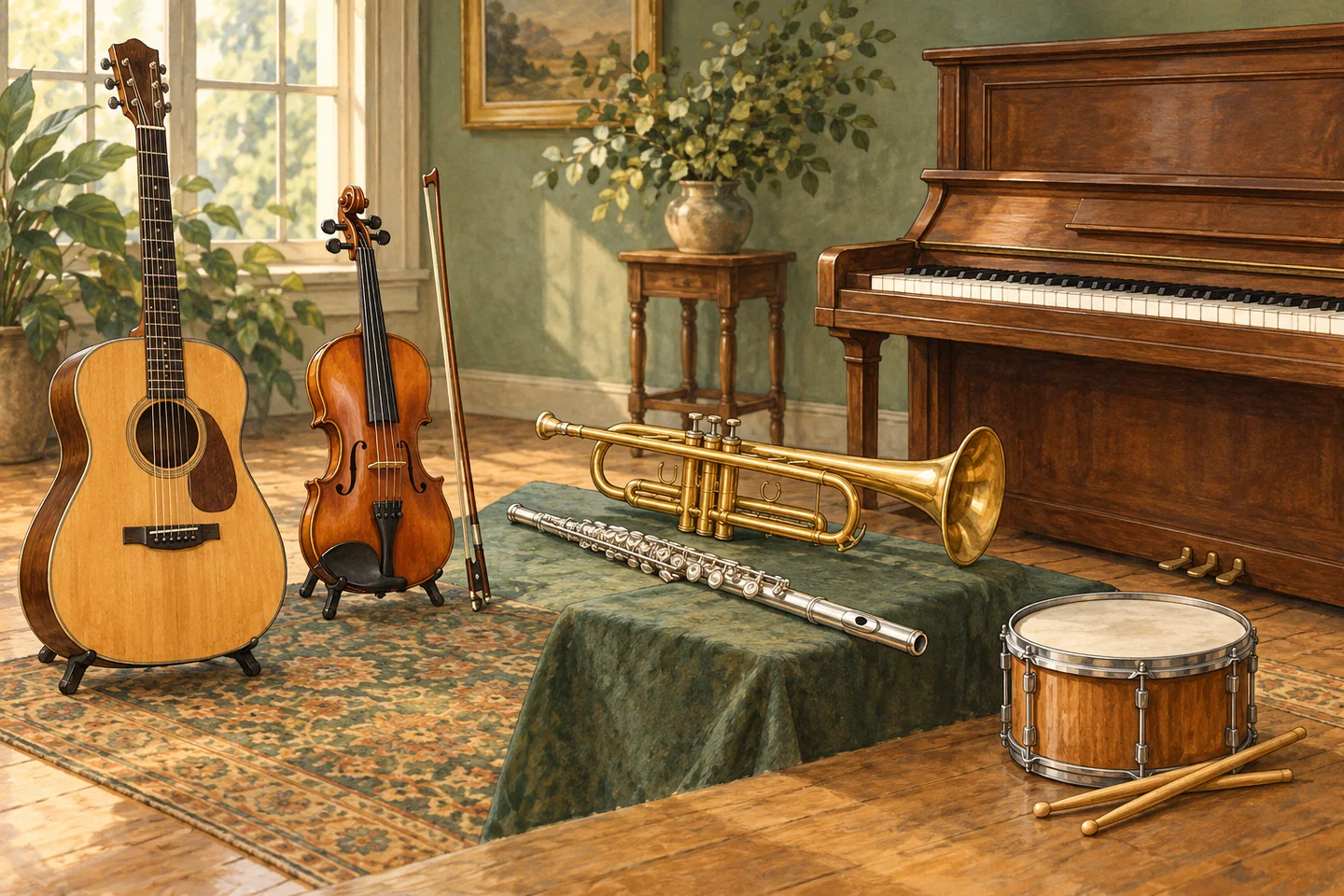
- die Gitarre
- die Geige
- die Querflöte
- die Trompete
- das Klavier
- die Trommel
Which instruments have strings, which do you blow into, and which object is played by striking its surface?
Open the full illustrationLook at the whole outline before reading the label. The Gitarre has a long neck and strings. The pictured Geige is paired with a bow. The Klavier has a keyboard and a large body. The Trompete has a mouthpiece and a flared end. The flute pictured here is specifically a Querflöte; its blowing hole is on the side. The last object is one Trommel, not a complete drum kit.
Point to an object and recall its name. Then read a name and choose the object without following the order of the labels.
Three distinctions that prevent naming errors
Die Geige and die Violine are two names for the violin. They do not mean that you must be looking at two different instruments. A cello is a different, larger string instrument, so it needs a different name. The article belongs to the name you choose: die Geige, die Violine.
Die Flöte is a broader name. Die Querflöte and die Blockflöte identify more specific types. A recorder held in front of the player is not the same pictured object as a transverse flute held across the body. Use the precise name when the type matters; a general flute word does not supply that distinction.
Die Trommel names one drum. Das Schlagzeug can name a collection of percussion instruments played together, such as a drum kit. A kit can include several drums and cymbals. The normal activity phrase Schlagzeug spielen therefore does not require that you name every part separately. In a picture containing one drum, Trommel is the accurate label.
Use a few recognition groups
For recall, group objects by an action or visible feature. Strings connect Gitarre, Geige and Harfe. Blowing connects Querflöte, Trompete and Klarinette. Keys help you recognize the Klavier; striking the surface helps you recognize the Trommel. These are practical memory groups, not a complete technical classification of how instruments produce sound.
One instrument can have more than one useful feature. A piano has keys and strings. An accordion can have keys or buttons and a bellows. Do not force the nouns into a rule that says every instrument has only one feature. Instead, write a short description that helps you retrieve its name: Das Instrument hat Tasten. Es ist ein Klavier. Add context if several answers would fit.
Playing an instrument and identifying one
For the activity, the simple pattern usually has no article: Ich spiele Gitarre. Sie spielt Geige. Wir spielen Klavier. To say you are learning, use Ich lerne Trompete spielen.
When referring to an individual object, an article has a job: Das ist eine Gitarre. Ich habe eine Gitarre. Die Gitarre ist alt. With the neuter piano: Ich habe ein Klavier. Do not remove articles from every sentence simply because an activity phrase leaves one out.
A fictional choice: A: Welches Instrument möchtest du lernen? B: Ich möchte Querflöte lernen. A: Spielst du schon ein Instrument? B: Ja, ich spiele Klavier. The instrument names stay clear without a long musical biography. For further activity questions, use the existing hobbies vocabulary and conversation guide.
To describe what you hear, continue with German words for listening and sound. For the spelling of a musical string, see the Saite and Seite comparison. Those are separate learning tasks from naming the instrument.
Eight instrument naming tasks
Give a specific answer where the question supplies a specific shape or playing position. Open tasks include model answers; other answers may also be correct.
Task 1: Recall three articles
Add the articles: ___ Gitarre, ___ Klavier, ___ Trommel.
Answer and explanation
die Gitarre, das Klavier, die Trommel. Do not assign one gender to all instruments.
Task 2: Make the plural
Write: eine Geige – zwei ___; ein Klavier – zwei ___.
Answer and explanation
zwei Geigen; zwei Klaviere. Geige adds -n; Klavier adds -e.
Task 3: Choose the exact flute name
Which word fits a flute with a side blowing hole: Querflöte or Blockflöte?
Answer and explanation
die Querflöte. The name matches the sideways playing position and side opening, rather than a recorder mouthpiece at the end.
Task 4: Name one percussion object
A picture shows a single drum. Should its label be die Trommel or das Schlagzeug?
Answer and explanation
die Trommel. Schlagzeug can refer to a setup with several percussion instruments; one drum does not by itself show the full setup.
Task 5: Recognize a synonym
Does Violine name a second instrument alongside Geige?
Answer and explanation
In this reference both name the violin: die Violine / die Geige. A synonym does not add another physical instrument to an inventory.
Task 6: Repair the activity sentence
Make a normal activity sentence from ich / Gitarre / spielen.
Answer and explanation
Ich spiele Gitarre. The activity pattern commonly leaves out the article. An individual object can take one: Ich habe eine Gitarre.
Task 7: Check a description
Someone says: “It has keys, so it cannot have strings.” Is that description reliable for a piano?
Answer and explanation
No. A piano has keys and strings. Use features to recognize the instrument without treating your memory groups as mutually exclusive scientific categories.
Task 8: Choose and explain
Write two German sentences: name an instrument you play or want to learn, then name a different instrument you can recognize.
Answer and explanation
One possible answer: Ich möchte Trompete lernen. Das ist eine Geige. You can choose other instruments. Check the activity phrase and the article in the identification sentence separately.
Choose three names for your next conversation
Select three instruments that matter to you. Say each name with its article, make the plural, then use it in a sentence about playing or learning. On your next review, start from the image rather than the English translation. If you cannot recognize the object yet, return to its distinguishing feature before adding a more advanced instrument name.
Questions about this topic
How do I say I play guitar in German?
Ich spiele Gitarre is the ordinary activity sentence. To identify or refer to one physical guitar, use an article where needed: Das ist eine Gitarre. Die Gitarre ist alt.
Are Geige and Violine different instruments?
Both names refer to the violin: die Geige and die Violine. A cello is a different, larger string instrument.
Is one drum called Schlagzeug?
For one pictured drum, die Trommel is the precise label. Das Schlagzeug can refer to a group of percussion instruments played together, such as a drum kit.
Can I guess an instrument’s article from its size?
There is no dependable size rule for this reference. Learn the article with each noun, such as die Gitarre and das Klavier.
Sources and further learning
- Duden: Gitarre
- Duden: Geige
- Duden: Klavier
- Duden: Querflöte
- Duden: Trommel
- Duden: Schlagzeug
- Goethe-Institut: Mehr als Deutsch!, Musik
Source links checked: .
Use this in your German practice
Try the examples and answer checks on this page. For a wider routine, explore Lingeva’s grammar, vocabulary and speaking practice. Available app features and plan allowances are explained on the plan page.