
Find everyday names on a body map
Begin with the larger areas, then add smaller parts. Der Körper is the body as a whole. Der Kopf is at the top; der Arm and das Bein are different limbs. Use the drawing as a route through the vocabulary rather than trying to memorize eighteen unrelated translations at once.
Find the word on the body
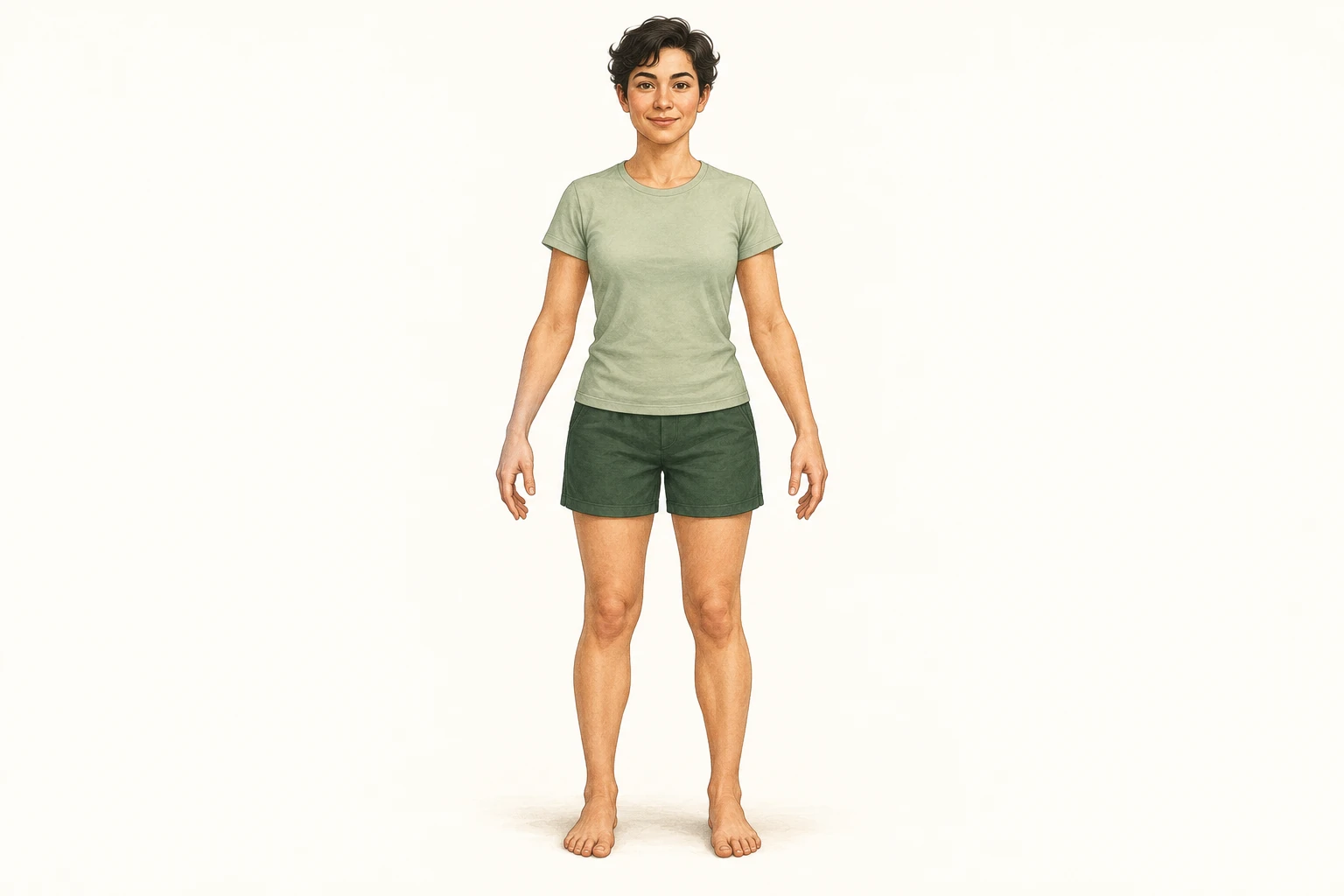
- der Kopfhead
- der Halsneck
- die Schultershoulder
- der Armarm
- die Handhand
- der Bauchbelly
- das Beinleg
- das Knieknee
- der Fußfoot
The sketch shows a few useful anchor words. Face words such as das Auge and die Nase are in the table rather than crowded onto a small drawing. Point to a location, name it with the article, then read the full singular–plural pair below. You can do the task with a simple drawing on paper too.
Body parts with articles and plurals
| Singular with article | Plural | Meaning |
|---|---|---|
| der Kopf | die Köpfe | head |
| das Gesicht | die Gesichter | face |
| das Auge | die Augen | eye |
| das Ohr | die Ohren | ear |
| die Nase | die Nasen | nose |
| der Mund | die Münder | mouth |
| der Zahn | die Zähne | tooth |
| der Hals | die Hälse | neck / throat |
| die Schulter | die Schultern | shoulder |
| der Arm | die Arme | arm |
| die Hand | die Hände | hand |
| der Finger | die Finger | finger |
| der Bauch | die Bäuche | belly / abdomen |
| der Rücken | die Rücken | back |
| das Bein | die Beine | leg |
| das Knie | die Knie | knee |
| der Fuß | die Füße | foot |
| der Zeh | die Zehen | toe |
Keep der Arm and die Hand separate: the hand is not the whole arm. Similarly, das Bein is a leg, while der Fuß is the foot at its end. English already distinguishes these names, but a hurried translation can still attach a word to the wrong part of a picture.
Der Bauch is the everyday belly or abdominal area; it is not simply another name for the internal organ called der Magen. Der Hals can refer to the neck or throat, depending on context. This reference focuses on recognizing everyday words; it does not attempt an anatomical list of internal organs.
Learn changes in the plural as complete pairs
Notice umlauts in Kopf – Köpfe, Hand – Hände, Fuß – Füße and Zahn – Zähne. Arm – Arme and Bein – Beine add -e without the same vowel change. Auge – Augen, Ohr – Ohren and Schulter – Schultern use other familiar endings. Store the whole pair rather than guessing that all body words behave alike.
Some written plurals look unchanged: der Finger – die Finger, der Rücken – die Rücken, das Knie – die Knie. Number and context help: ein Knie – zwei Knie. For Knie, dictionary pronunciation allows a plural with two syllables and also a one-syllable form; do not invent an extra written e to represent that difference. The noun-plural guide gives broader patterns.
Keep left and right tied to the person
Links means left and rechts means right. When describing someone’s body, decide whose perspective you mean. If a person faces you, their left hand appears on your right. Use deine linke Hand or meine rechte Hand when that makes the reference clearer instead of relying on a vague point at the picture.
In short naming phrases, compare die linke Hand, der rechte Arm and das linke Bein. These are nominative examples. The ending on linke or rechte belongs to the noun phrase; the dictionary word for “left” or “right” does not solve every ending in a full sentence. Start with two clear labels and swap the side deliberately.
Use a small number of clear location phrases
For a stationary mark on a drawing, use Ein Punkt ist auf der Hand or Ein Punkt ist am Arm. Am is the contracted form of an dem. These examples describe where something is; they do not teach every possible use of auf and an. Keep the reference situation fixed while learning the phrase.
You can name a part without a location phrase: Das ist die Schulter. Das sind die Schultern. Singular ist and plural sind should match the noun. If your goal is describing symptoms and answering a clinician’s questions, continue with the existing German doctor-visit practice guide. Here the main task is naming the correct part.
For spelling, preserve ä in Hände and ü in Füße. The alphabet guide helps you spell unfamiliar forms. Say a full pair aloud before using it in a new sentence rather than learning only a rough English respelling.
Eight body-word checks with explanations
Try each task before revealing the explanation. A correct name includes its article when requested. The practice is about naming, number and position.
Name the whole arm, with its article.
Check answer and explanation
der Arm
Die Hand is the hand at the end of the arm. Keep the larger limb and the smaller part separate.
Name a foot, then two feet.
Check answer and explanation
der Fuß – zwei Füße
The plural changes u to ü and adds -e. In German spelling the word still contains ß.
Complete: die Hand – die ___.
Check answer and explanation
die Hände
The plural adds -e and changes a to ä. Handen is not the nominative plural here.
Write two knees in German.
Check answer and explanation
zwei Knie
The written plural remains Knie. A possible pronunciation difference does not add an extra e in spelling.
Which word names the back: Bauch or Rücken?
Check answer and explanation
der Rücken
Der Bauch is at the front of the torso; der Rücken is at the back and is not visible in the front-view sketch.
Name “the left hand” as a nominative label.
Check answer and explanation
die linke Hand
Die Hand takes linke in this label. Left is from the relevant person’s perspective, which can differ from the viewer’s.
Complete the stationary location: Ein Punkt ist auf ___ Hand.
Check answer and explanation
Ein Punkt ist auf der Hand.
This example describes a location. With die Hand, the dative phrase here is auf der Hand.
Name several teeth in a full identifying sentence.
Check answer and explanation
Das sind die Zähne.
Use sind for the plural. Zahn changes to Zähne, including an umlaut and -e.
Turn the map into a retrieval task
Draw a plain outline and add six labels from memory. Use three larger areas and three smaller parts. Next to each label, write its plural. Compare with the table only after you have tried. Correct the exact form you missed rather than copying every entry again.
On a second pass, ask yourself to identify left or right from the person’s perspective. Then describe one mark on the drawing with a location phrase. Change the order of the labels at your next review. You are checking whether you can connect a name to a place, not whether you can repeat a familiar list from top to bottom.
Questions about this topic
What is the difference between Bein and Fuß?
Das Bein is the leg; der Fuß is the foot at its end. Their plurals are die Beine and die Füße.
How do you say body parts in German?
The category is die Körperteile. A single body part is der Körperteil. Useful examples are der Kopf, die Hand, das Knie and der Fuß.
Is the plural of Knie written Kniee?
No. The standard written plural is die Knie. Dictionary pronunciation includes a two-syllable plural and a one-syllable option; neither changes the spelling.
Whose left is meant on a body diagram?
For a person’s left hand, use that person’s perspective. Someone facing you has their left on your right. Say meine or deine when that makes the description clearer.
Sources and further learning
- DW Deutschtrainer: Körperteile – core names and plurals
- Duden: Fuß – plural Füße
- Duden: Knie – plural spelling and pronunciation variants
- Duden: Auge
- Duden: Ohr
- Duden: Schulter
- Duden: Zeh – plural Zehen
- Duden: Körperteil – category noun and plural
- Duden: Magen – organ sense
Source links checked: .
Use this in your German practice
Try the examples and answer checks on this page. For a wider routine, explore Lingeva’s grammar, vocabulary and speaking practice. Available app features and plan allowances are explained on the plan page.