
Furniture names to learn as complete units
Learn der Stuhl – die Stühle together. The article belongs to the singular noun; the plural can change both the ending and the vowel. In the table, die before a plural means “the” for several objects. It does not tell you the singular gender. Read each pair aloud, then identify a real object near you.
| Singular | Plural | Meaning |
|---|---|---|
| der Tisch | die Tische | table |
| der Stuhl | die Stühle | chair |
| das Sofa | die Sofas | sofa |
| der Sessel | die Sessel | armchair |
| der Schrank | die Schränke | cupboard / wardrobe |
| das Regal | die Regale | shelving unit / shelves |
| die Kommode | die Kommoden | chest of drawers |
| das Bett | die Betten | bed |
| der Schreibtisch | die Schreibtische | desk |
| der Nachttisch | die Nachttische | bedside table |
| der Kleiderschrank | die Kleiderschränke | wardrobe |
| die Lampe | die Lampen | lamp |
| der Teppich | die Teppiche | rug / carpet |
| der Spiegel | die Spiegel | mirror |
| das Kissen | die Kissen | cushion / pillow |
| die Matratze | die Matratzen | mattress |
The table uses Sessel for an armchair, as in standard usage in Germany. Regional vocabulary can differ. A room may have several jobs, so you can use a Schreibtisch in a living room or a bedroom. The object keeps its name when you move it.
Find six objects in the room
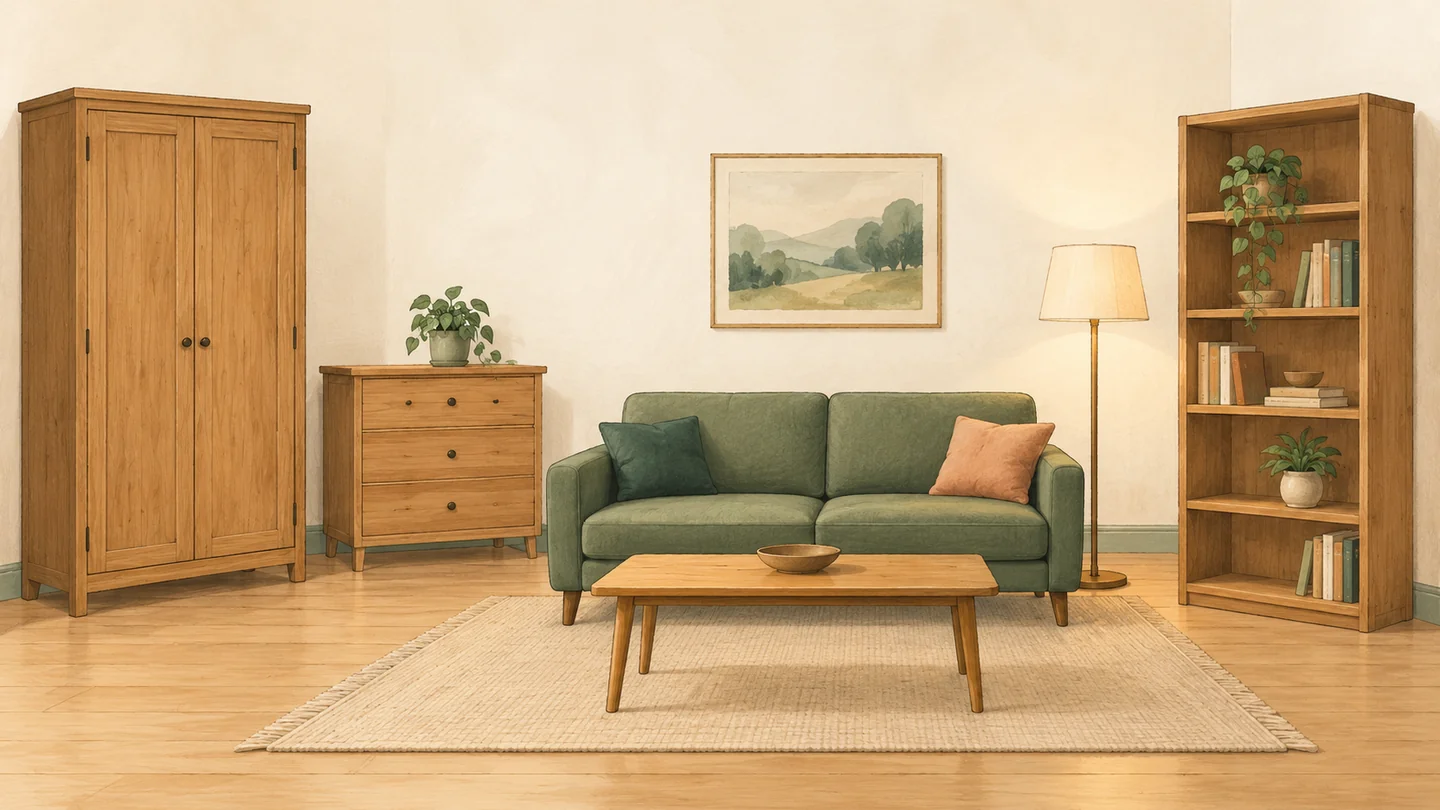
- der Schrank
- die Kommode
- das Regal
- das Sofa
- der Couchtisch
- die Stehlampe
Which object has open shelves, which has drawers, and which has doors?
Open the full illustrationUse the scene for identification before writing a description. Point to the sofa and say das Sofa. Then choose a different object without following the order of the key. Recognizing the picture and recalling the German name are separate tasks; practise both. The fictional arrangement is a learning scene, not a model of how homes in Germany must look.
The low table is der Couchtisch – die Couchtische, a coffee table. The tall freestanding lamp is die Stehlampe – die Stehlampen. These are more precise names than Tisch and Lampe. The chair in the main reference is not shown in this room.
Schrank, Kommode and Regal
For this reference, focus on the storage you can see. A Schrank provides enclosed storage, commonly behind doors. A Kommode is a chest of drawers. A Regal has shelves; the illustration shows open shelving. These everyday categories help you choose a useful name, although real furniture can combine doors, drawers and open sections.
der Kleiderschrank specifies a wardrobe for clothes. das Bücherregal specifies shelving for books. The final noun supplies the gender: der Schrank → der Kleiderschrank, das Regal → das Bücherregal. If you cannot identify a mixed design precisely, use das Möbelstück and describe the part you mean.
die Schublade means “drawer”; it is a part of a chest or cupboard. das Fach means a compartment or shelf space. Saying Die Kommode hat drei Schubladen identifies a feature without needing the vocabulary for its material, style or price.
Rooms give you a place to organize the words
| Room | English | Possible objects |
|---|---|---|
| das Wohnzimmer | living room | das Sofa, der Sessel, das Regal |
| das Schlafzimmer | bedroom | das Bett, die Matratze, der Kleiderschrank |
| das Arbeitszimmer | study / home office | der Schreibtisch, der Stuhl |
| das Esszimmer | dining room | der Tisch, die Stühle |
| die Küche | kitchen | der Küchentisch, der Küchenstuhl |
| das Badezimmer | bathroom | der Spiegel, der Schrank |
These combinations are examples, not rules about where furniture belongs. Choose one room you know and write only the objects actually in it. Keep equipment such as pots and pans on a separate kitchen list. For the meanings of Haus, Zuhause and Wohnung, use the existing home and place word comparisons.
Use the names in short, useful sentences
Begin with an identification: Das ist ein Tisch. Das ist eine Kommode. Das ist ein Regal. The singular patterns are ein with masculine or neuter nouns and eine with feminine nouns here. For several objects, say Das sind zwei Stühle. Keep the umlaut in Stühle and Schränke.
To say what you have, use Ich habe einen Tisch, eine Lampe und ein Bett. The masculine article changes to einen after habe in this example. For a simple inventory, Ich habe zwei Regale avoids an indefinite plural article: German has no plural form of ein in this use.
English “furniture” is commonly expressed as Möbel: Die Möbel sind alt. To count individual items clearly, use ein Möbelstück, zwei Möbelstücke. The dictionary also records singular das Möbel; it would be inaccurate to say that the word can never have a singular. Use Möbelstück for your first counting sentences.
When you are ready to explain where an object stands or where you put it, continue with position and placement verbs. Here, keep your attention on choosing the object name.
Eight furniture recall tasks
Try each task before opening its answer. For an open task, compare the example with your own words rather than copying it.
Task 1: Choose by feature
A low storage object has three drawers. Choose Schrank, Kommode or Regal and include the article.
Answer and explanation
die Kommode. Drawers are the feature that distinguishes this object in the reference. A real design may combine storage types.
Task 2: Restore the plural
Complete: ein Stuhl – zwei ___; ein Schrank – zwei ___.
Answer and explanation
zwei Stühle; zwei Schränke. Both plurals add an ending and change the vowel. Keep the umlaut when writing.
Task 3: Keep an unchanged plural
Complete: ein Sessel – drei ___; ein Spiegel – zwei ___.
Answer and explanation
drei Sessel; zwei Spiegel. The noun spelling stays the same; the number makes the plural clear.
Task 4: Identify open storage
Your books are visible on several open shelves. What is the whole piece called?
Answer and explanation
das Regal, or more specifically das Bücherregal. One shelf or compartment is not necessarily the whole piece.
Task 5: Repair an inventory
Correct: Ich habe ein Tisch und zwei Regals.
Answer and explanation
Ich habe einen Tisch und zwei Regale. Tisch is masculine; this object after habe uses einen. The plural of Regal is Regale.
Task 6: Count furniture pieces
Complete naturally: Wir brauchen noch zwei ___: ein Bett und einen Schrank.
Answer and explanation
Möbelstücke. It counts individual pieces: a bed and a wardrobe. Möbel alone is a broad furnishing word.
Task 7: Build a compound
Name a wardrobe for clothes in German. Give its article and plural.
Answer and explanation
der Kleiderschrank – die Kleiderschränke. The final component Schrank determines the gender and plural pattern.
Task 8: Create a room inventory
Name four objects in a room you know. Include one plural, then write two complete German sentences.
Answer and explanation
One possible answer: Ich habe ein Bett und einen Schreibtisch. Ich habe zwei Lampen und drei Kissen. Your objects can differ. Check each article and keep the noun capitalized.
Make your next review smaller
Choose five objects, rather than rereading the entire table. Look at each object, retrieve its article and name, then retrieve its plural. Check only after answering. Next time, change the order or describe a different room. Use the article recall worksheet if you keep recognizing a noun but losing der, die or das.
Questions about this topic
What is the German word for furniture?
Möbel is the usual collective reference to furnishings. For one individual piece, ein Möbelstück is a clear everyday choice. Dictionaries also record singular das Möbel.
What is the difference between Schrank and Regal?
In the pictured contrast, der Schrank is enclosed storage with doors; das Regal is open shelving. Real furniture can combine these features, so name the part or describe it when needed.
Is the plural of Stuhl Stuhls?
No. The plural is die Stühle. Learn der Stuhl and die Stühle together, including the umlaut.
Does every German room have these objects?
No. The rooms and furnishings are fictional examples for naming practice. Homes, room uses and furniture arrangements differ.
Sources and further learning
- Duden: Möbel
- Duden: Schrank, Deklination
- Duden: Kommode
- Duden: Regal
- Goethe-Institut: Goethe-Zertifikat B1, Wortliste
Source links checked: .
Use this in your German practice
Try the examples and answer checks on this page. For a wider routine, explore Lingeva’s grammar, vocabulary and speaking practice. Available app features and plan allowances are explained on the plan page.