
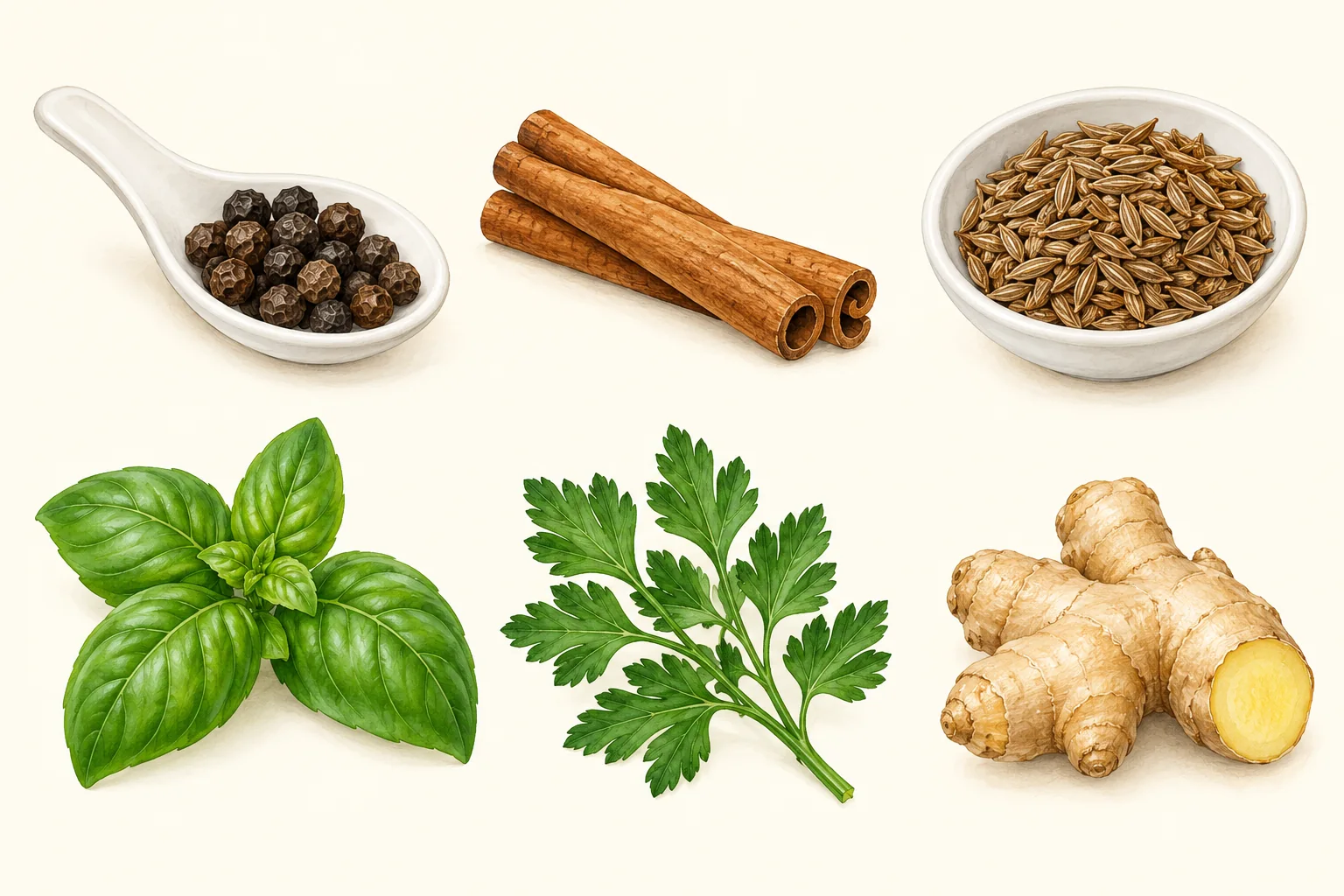
Names to recognise on a jar or recipe
The examples show common forms around the ingredient name. They are not instructions to buy, eat or combine the ingredients.
| German noun | English meaning | Example phrase |
|---|---|---|
| der Pfeffer | pepper | schwarzer Pfeffer |
| der Zimt | cinnamon | gemahlener Zimt |
| der Kümmel | caraway | ganzer Kümmel |
| der Kreuzkümmel | cumin | gemahlener Kreuzkümmel |
| der Koriander | coriander / cilantro | frischer Koriander |
| das Basilikum | basil | frisches Basilikum |
| der Rosmarin | rosemary | getrockneter Rosmarin |
| der Thymian | thyme | frischer Thymian |
| der Oregano | oregano | getrockneter Oregano |
| die Petersilie | parsley | frische Petersilie |
| die Muskatnuss | nutmeg | eine Muskatnuss |
| der Ingwer | ginger | frischer Ingwer |
| der Dill | dill | frischer Dill |
| die Vanille | vanilla | gemahlene Vanille |
| der Safran | saffron | etwas Safran |
Replay a line, transcript and audio files
der Pfeffer.
Open audio file 1der Zimt.
Open audio file 2der Kümmel.
Open audio file 3der Kreuzkümmel.
Open audio file 4der Koriander.
Open audio file 5das Basilikum.
Open audio file 6der Rosmarin.
Open audio file 7der Thymian.
Open audio file 8der Oregano.
Open audio file 9die Petersilie.
Open audio file 10die Muskatnuss.
Open audio file 11der Ingwer.
Open audio file 12der Dill.
Open audio file 13die Vanille.
Open audio file 14der Safran.
Open audio file 15
Read the words around the ingredient
Ganz means whole in a label such as ganzer Kümmel; gemahlen means ground. Getrocknet means dried, while frisch means fresh. Adjective endings vary with the complete phrase: der gemahlene Zimt, but gemahlener Zimt without an article.
Kümmel and Kreuzkümmel are different ingredients: caraway and cumin. A shared word part does not make them interchangeable. Koriander can occur in references to the plant, leaves or seeds, so check the surrounding label instead of assuming one product form.
Ask for a missing ingredient
- Kundin
- Entschuldigung, wo finde ich Kreuzkümmel?
- Mitarbeiter
- Bei den Gewürzen, neben dem Pfeffer.
- Kundin
- Gibt es ihn auch gemahlen?
- Mitarbeiter
- Bitte schauen Sie auf das Etikett. Dort steht, welche Form es ist.
- Kundin
- Danke, ich sehe nach.
Turn a recipe label into a retrieval task
Choose five names from the table. Cover the English meanings and retrieve them. Then use one label word: frisches Basilikum, getrockneter Oregano or gemahlener Zimt. Keep the noun article in your notes, even when the recipe omits it.
Write a question using Ich suche … and one using Wo finde ich …? Finally, explain the distinction between Kümmel and Kreuzkümmel in your own words. Use the existing food and shopping lessons for a full purchase conversation rather than adding unrelated cooking advice here.
Put it into practice
Try each task before opening the answer. Open questions show one possible model answer.
Give the article with Basilikum.
Answer and explanation
das Basilikum
The noun is neuter.
Which word means ground on a spice label?
Answer and explanation
gemahlen
It describes the product form, unlike ganz.
Are Kümmel and Kreuzkümmel the same ingredient?
Answer and explanation
No. Kümmel is caraway; Kreuzkümmel is cumin.
Similar spelling does not make the ingredient names equivalent.
Complete without an article: __ Basilikum. (frisch)
Answer and explanation
frisches
The neuter nominative/accusative material phrase takes frisches here.
Ask where you can find pepper.
Answer and explanation
Wo finde ich Pfeffer?
This is a complete request for a location.
Give the English meaning of Petersilie.
Answer and explanation
parsley
Do not confuse it with coriander simply because both can be fresh herbs.
Questions learners ask
Why do recipes omit articles?
Ingredient lists often use compressed noun phrases. Learn the full dictionary noun alongside the shorter label form.
Are Gewürz and Kraut the same word?
Gewürz names a spice or seasoning; Kraut can name a herb or leafy plant. For parsley and basil, learn the specific ingredient name as well as the broader category.