
Utensils, cookware and tableware
Keep each noun with its article and plural. Der Topf – die Töpfe has an umlaut in the plural; das Messer – die Messer keeps the same spelling. English kitchen words are sometimes broad. “Spatula” can name several tools, so this guide uses Pfannenwender for a flat tool used to turn food in a pan.
| Singular | Plural | Meaning |
|---|---|---|
| der Topf | die Töpfe | cooking pot |
| die Pfanne | die Pfannen | frying pan |
| der Deckel | die Deckel | lid |
| das Sieb | die Siebe | sieve / strainer |
| die Schüssel | die Schüsseln | bowl |
| das Schneidebrett | die Schneidebretter | chopping board / cutting board |
| der Pfannenwender | die Pfannenwender | turner / cooking spatula |
| der Kochlöffel | die Kochlöffel | cooking spoon |
| das Messer | die Messer | knife |
| die Gabel | die Gabeln | fork |
| der Löffel | die Löffel | spoon |
| der Teller | die Teller | plate |
| die Tasse | die Tassen | cup |
| das Glas | die Gläser | drinking glass |
These groups overlap in everyday usage. Das Besteck means cutlery, including knives, forks and spoons. Das Geschirr refers to dishes or tableware. Use these collective words when discussing the group, and ein Messer or zwei Teller when identifying individual objects.
Six objects and their distinguishing features
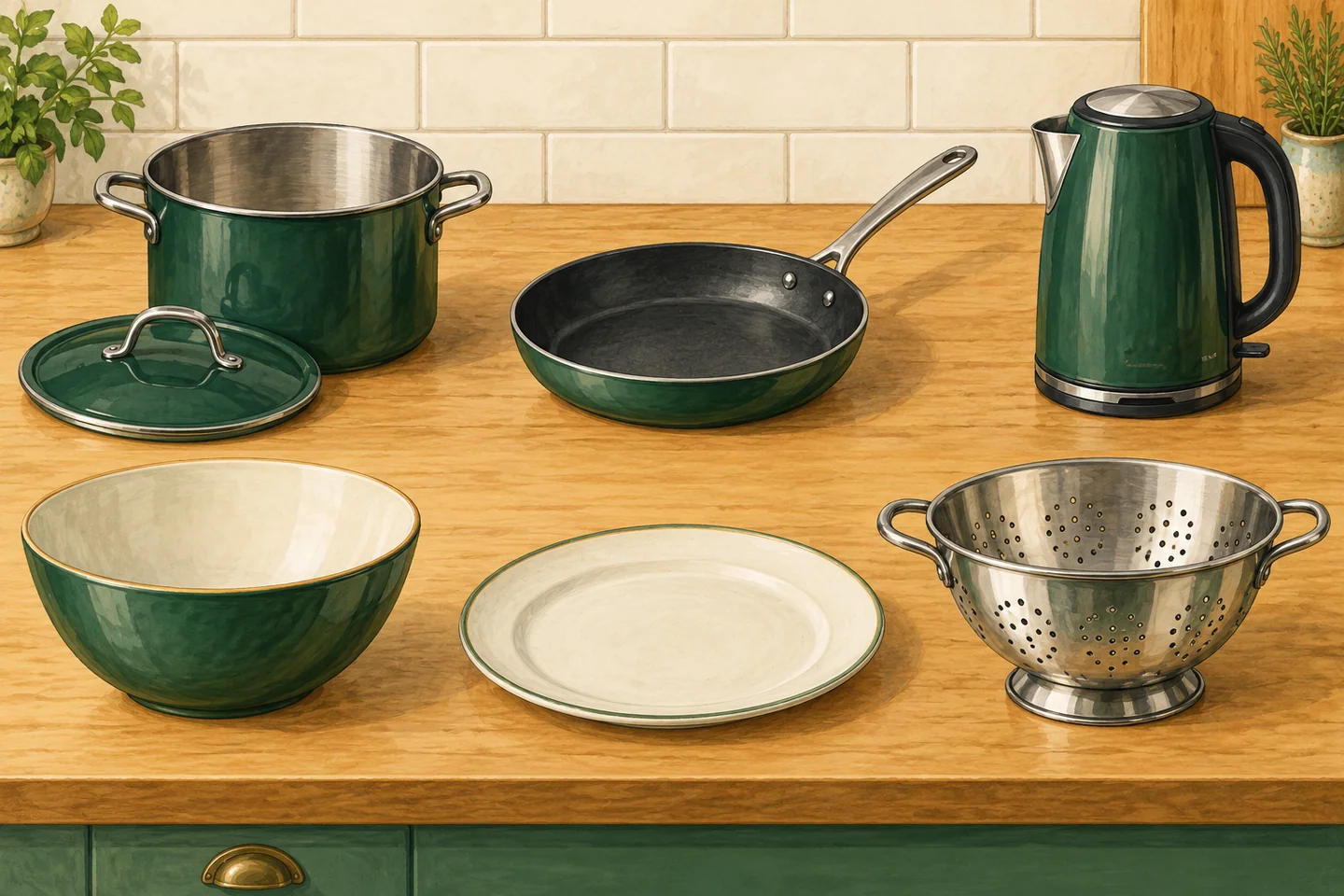
- der Topf
- die Pfanne
- die Schüssel
- der Teller
- das Sieb
- der Wasserkocher
Choose an object from its shape and purpose before checking the label.
Open the full illustrationA Topf is deeper than the Pfanne pictured here. A Sieb has holes or mesh; the solid Schüssel holds its contents. The Teller has a wide eating surface. The Wasserkocher is the appliance with a handle and pouring spout. Shape and purpose are more useful than colour: the same objects can come in other materials and designs.
The Schneidebrett and Pfannenwender in the reference are not pictured. The board provides a supporting surface; the turner has a handle and a flat turning end. Keep their names for a separate real-object check.
Cover the names and answer Was ist das? for each pictured object. Next, cover the image and sketch a quick outline from a German name. Include the distinguishing feature, such as mesh or the depth of a vessel. You are checking meaning, not drawing skill.
Appliances and fitted kitchen parts
| Singular | Plural | English |
|---|---|---|
| der Herd | die Herde | cooker / stove |
| der Backofen | die Backöfen | oven |
| der Kühlschrank | die Kühlschränke | refrigerator / fridge |
| der Wasserkocher | die Wasserkocher | electric kettle |
| die Spülmaschine | die Spülmaschinen | dishwasher |
Der Herd names the cooker or stove; der Backofen names the oven. They can form one combined appliance, but they do not name exactly the same part. Das Kochfeld is the hob or cooktop. Die Spüle is the kitchen sink; die Spülmaschine is the dishwasher. The longer word is not simply another name for the sink.
For a first equipment inventory, choose three things you can actually see: Hier sind ein Kühlschrank, ein Wasserkocher und eine Spülmaschine. Kitchen cupboards belong with furniture. Ingredients belong with food vocabulary; use the fruit and vegetable reference for those names.
Read compounds from the final noun
The final noun helps you organize a long equipment name. Das Brett gives das Schneidebrett; its plural is die Schneidebretter. Der Löffel gives der Kochlöffel; the plural die Kochlöffel adds no new ending. Keep the full word together when writing: Kochlöffel, not two separately capitalized nouns.
The same method explains der Kühlschrank – die Kühlschränke: the final part is Schrank. This helps with gender and the shape of the plural; it does not guarantee that the whole meaning is obvious. Learn the finished noun with an example. A refrigerator is an appliance, even though its word contains the noun for a cupboard.
Keep die Küche separate from der Kuchen. The first means kitchen or cuisine; the second means cake. The existing vowel and meaning comparisons explain the contrast. Do not remove umlauts from your kitchen word cards: Töpfe, Löffel and Kühlschrank need their written vowels.
Ask for one item, then check the response
Use a short request with the object name: Kannst du mir bitte das Sieb geben? You can replace the final noun: die Schüssel, das Schneidebrett or den Kochlöffel. In this request the masculine direct object has den, while feminine die and neuter das stay visibly the same.
A small fictional exchange: A: Brauchst du den Topf? B: Nein, ich brauche die Pfanne. A: Diese hier? B: Ja, danke. The correction names the intended object. When the word is missing, ask Wie heißt dieses Küchengerät auf Deutsch? and point to the item. That question is more useful than guessing a technical name from its appearance.
Eight kitchen vocabulary tasks
Make a choice before opening the answer. Several tasks check whether you can distinguish objects, rather than merely repeat a translated list.
Task 1: Choose the vessel
Which name fits the deep cooking vessel: Topf or Pfanne? Include its article.
Answer and explanation
der Topf. The deep shape distinguishes it from the shallow frying pan in this reference.
Task 2: Choose by material structure
You need the object with holes or mesh. Choose Sieb or Schüssel and give its plural.
Answer and explanation
das Sieb – die Siebe. The openings distinguish it from a solid bowl.
Task 3: Complete two plurals
Write the missing words: ein Topf – zwei ___; ein Schneidebrett – zwei ___.
Answer and explanation
zwei Töpfe; zwei Schneidebretter. Topf changes its vowel; Schneidebrett follows the plural of Brett.
Task 4: Name the flat handheld tool
Choose the tool used for turning food in a pan: Schneidebrett or Pfannenwender.
Answer and explanation
der Pfannenwender. The Schneidebrett is the supporting board. An English “spatula” translation alone can be ambiguous.
Task 5: Separate two kitchen names
Which is the sink, die Spüle or die Spülmaschine? Which is the appliance?
Answer and explanation
die Spüle is the sink; die Spülmaschine is the dishwasher. The second word ends in Maschine.
Task 6: Repair a request
Correct the article: Kannst du mir bitte der Kochlöffel geben?
Answer and explanation
Kannst du mir bitte den Kochlöffel geben? The masculine direct object needs den here. Mir identifies the recipient.
Task 7: Sort a small inventory
Group Gabel, Teller, Kühlschrank, Löffel as cutlery, tableware or appliance.
Answer and explanation
Cutlery: die Gabel, der Löffel. Tableware: der Teller. Appliance: der Kühlschrank. These are practical learning groups, not a claim that all everyday category uses are rigid.
Task 8: Write and correct a request
Ask for a bowl in German. Then imagine you receive a sieve and politely name the item you intended.
Answer and explanation
One answer: Kannst du mir bitte die Schüssel geben? Ich brauche die Schüssel, nicht das Sieb. The correction keeps the object names explicit.
Build a five-item kitchen check
Write five equipment names you use often, each with article and plural. Shuffle the order and name the real objects without reading. Next, ask for two of them in full sentences. If the plural fails, practise that exact pair again rather than adding ten new words. On a later round, give only a feature as a clue and let a partner choose the object.
Questions about this topic
What is the difference between Topf and Pfanne?
Der Topf is a cooking pot; die Pfanne is a frying pan. In this reference the pot is deep and the pan shallow. Learn both nouns with their articles and plural forms.
Does Pfannenwender mean every kind of spatula?
No. It names a flat turning tool used in a pan. English spatula can also refer to other shapes and uses, so identify the exact tool before choosing a German word.
What is the difference between Herd and Backofen?
Der Herd names the cooker or stove; der Backofen names the oven. The oven can be part of a combined cooker. Das Kochfeld names the hob or cooktop.
Is Messer masculine because it ends in -er?
No. The noun is das Messer and the plural is die Messer. Do not use an ending alone as a reliable gender rule for all equipment names.
Sources and further learning
- Goethe-Institut: Wort-Bild-Paare, Küchengeräte
- Duden: Pfannenwender
- Duden: Sieb
- Duden: Schneidebrett, Deklination
- Duden: Backofen
- Goethe-Institut: Goethe-Zertifikat B1, Wortliste
Source links checked: .
Use this in your German practice
Try the examples and answer checks on this page. For a wider routine, explore Lingeva’s grammar, vocabulary and speaking practice. Available app features and plan allowances are explained on the plan page.