
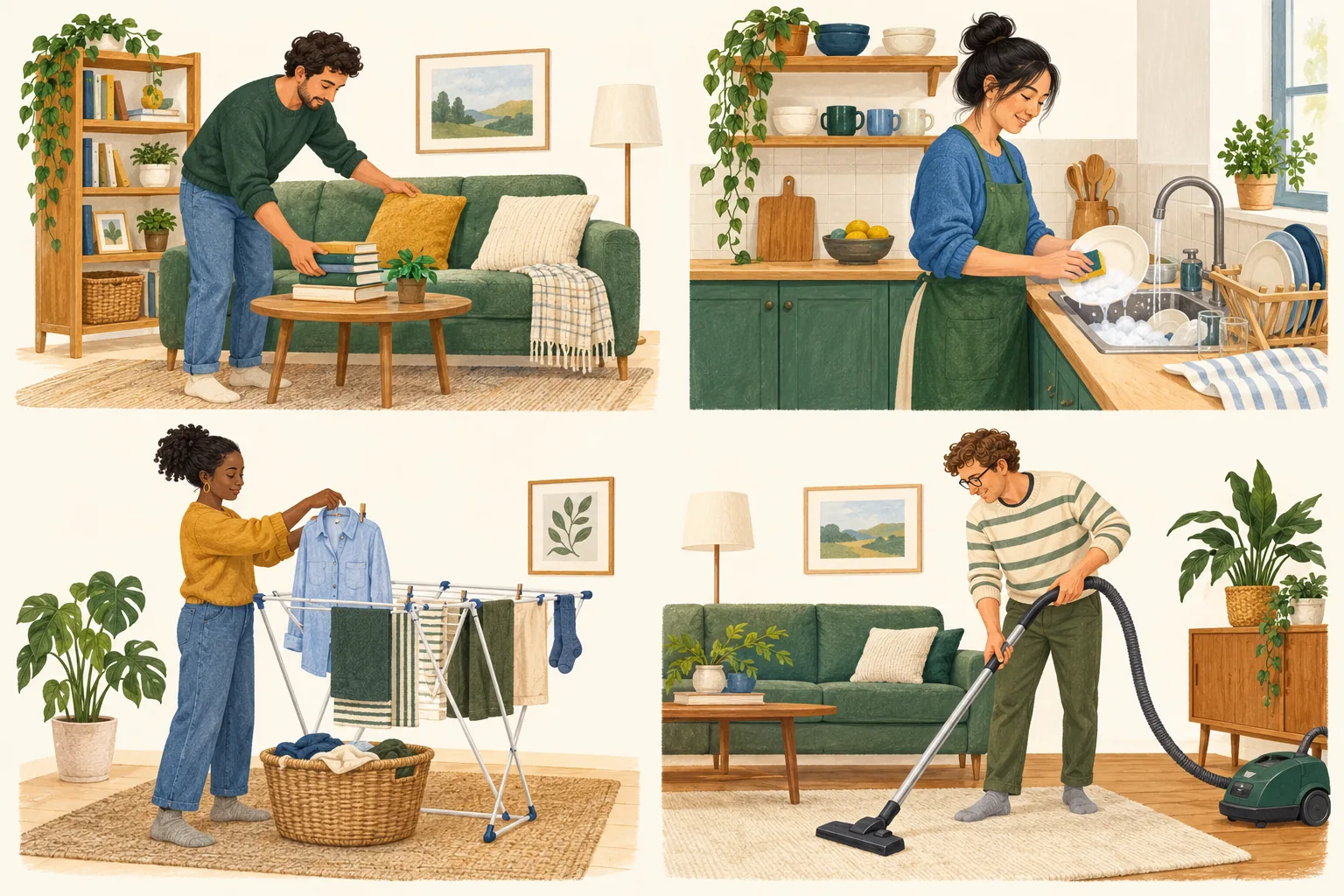
Ten chores as complete phrases
Read the full sentence, including any verb part at the end. A dictionary infinitive alone does not show the word order of a statement.
| Phrase | Original sentence | Meaning |
|---|---|---|
| aufräumen | Ich räume das Zimmer auf. | tidy up |
| abwaschen | Ich wasche das Geschirr ab. | wash dishes |
| Staub saugen | Ich sauge im Wohnzimmer Staub. | vacuum |
| wischen | Ich wische den Boden. | mop / wipe |
| putzen | Ich putze das Bad. | clean |
| Wäsche waschen | Ich wasche heute Wäsche. | do laundry |
| Wäsche aufhängen | Ich hänge die Wäsche auf. | hang laundry up |
| das Bett machen | Ich mache das Bett. | make the bed |
| den Müll hinausbringen | Ich bringe den Müll hinaus. | take out the rubbish |
| den Geschirrspüler ausräumen | Ich räume den Geschirrspüler aus. | empty the dishwasher |
Replay a line, transcript and audio files
Ich räume das Zimmer auf.
Open audio file 1Ich wasche das Geschirr ab.
Open audio file 2Ich sauge im Wohnzimmer Staub.
Open audio file 3Ich wische den Boden.
Open audio file 4Ich putze das Bad.
Open audio file 5Ich wasche heute Wäsche.
Open audio file 6Ich hänge die Wäsche auf.
Open audio file 7Ich mache das Bett.
Open audio file 8Ich bringe den Müll hinaus.
Open audio file 9Ich räume den Geschirrspüler aus.
Open audio file 10
Keep the separated part in the sentence
Aufräumen becomes Ich räume das Zimmer auf. In a request with können, use the infinitive at the end: Kannst du das Zimmer aufräumen? The spelling and position change with the construction.
With an imperative, choose the addressee: Räum bitte das Zimmer auf is informal singular. Räumen Sie bitte das Zimmer auf is polite address. A question such as Könntest du heute das Bad putzen? can leave more room for negotiation.
Replace a vague instruction with a useful agreement
Do not stop at Mach bitte sauber if the task needs a precise scope. Name the room or object and, when necessary, the time: Kannst du heute Abend den Küchenboden wischen?
Write one task you can take and one you want to ask about. Then practise declining or proposing a different time: Heute schaffe ich das nicht. Morgen früh kann ich es übernehmen. This is a model of coordination, not a requirement to use a particular tone in every household.
Put it into practice
Try each task before opening the answer. Open questions show one possible model answer.
Complete: Ich __ das Zimmer __. (aufräumen)
Answer and explanation
räume … auf
The finite part takes second position and auf closes this main-clause verb bracket.
Complete: Kannst du die Wäsche __? (aufhängen)
Answer and explanation
aufhängen
After können, this infinitive stays together at the end.
Say you are cleaning the bathroom today.
Answer and explanation
Ich putze heute das Bad.
Putzen takes the room as an accusative object.
Give a polite Sie instruction to tidy the room.
Answer and explanation
Räumen Sie bitte das Zimmer auf.
The polite imperative has Räumen Sie and the separated prefix auf.
Ask who is emptying the dishwasher.
Answer and explanation
Wer räumt den Geschirrspüler aus?
The question retains the separated part aus.
Say you can take the task tomorrow morning.
Answer and explanation
Morgen früh kann ich das übernehmen.
This model gives a concrete alternative time.
Questions learners ask
Is Staub saugen a useful phrase to learn?
Yes. The complete phrase Ich sauge Staub is easy to use. Other established spellings and constructions also exist; keep the model and its meaning together.
Does a polite question guarantee that a request sounds friendly?
No. Relationship, tone and circumstances matter. The guide gives adaptable language, not a universal rule for household etiquette.