
Coordinate the tongue and the lips
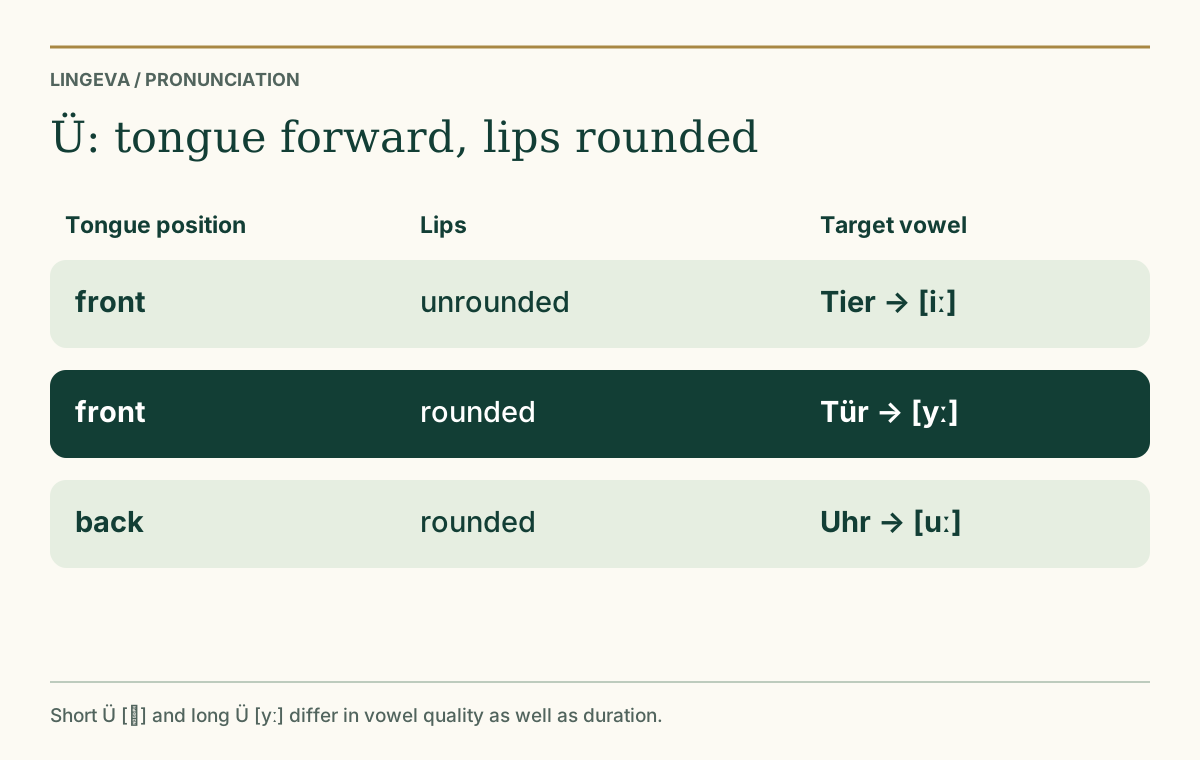
Begin with a German long I, as in Tier. Keep roughly that forward tongue position and round the lips to approach long Ü. A mirror can show whether the lips are rounded; compare the sound with the recording as well.
For U, the vowel is formed farther back. Both U and Ü may have rounded lips, so lip shape alone does not distinguish them. Change one feature at a time and listen to the resulting whole word.
Compare long and short Ü
Fühlen has long [yː] in the teaching model; füllen has short [ʏ]. Short Ü also has a different vowel quality. Speeding up a long vowel is not a complete instruction for producing the short one.
Keep a similar comfortable speaking pace while comparing the individual words. Then put each into a meaningful sentence. Preserve the umlaut in writing: ue is a conventional substitute when ü cannot be entered; simply removing the dots can create another word.
| Word | Target vowel | What to notice |
|---|---|---|
| Tier | [iː] | front, unrounded |
| Tür | [yː] | front, rounded |
| fühlen | [yː] | long Ü |
| füllen | [ʏ] | short Ü with a different quality |
Listen before opening the transcript
Play one model with its transcript closed. Decide which word you heard, then open the text and compare. Use the individual recordings in different orders so the sequence does not give you the answer.
Mutter and Mütter also differ as singular and plural forms. Fühlen and füllen are separate verbs. Connect each sound with the actual word and meaning rather than treating the umlaut as a decoration.
German audio
Move from one word to a useful reply
Start with Tür and Tier. Listen, repeat, and switch their order. Then make two short statements such as Die Tür ist offen and Das Tier schläft. Keep your attention on the vowel before increasing the sentence length.
For a second round, use Wir fühlen uns wohl and Wir füllen die Flasche. The complete sentences change several words, so they are not themselves minimal pairs. Compare the target words first, then practise the complete messages.
Choose one adjustment
If Ü keeps sounding like U, check the forward tongue position. If it sounds like I, check the lip rounding. If fühlen and füllen sound the same, compare the quality and duration of the two vowel models.
Record a short attempt and ask a listener to write the word they understood. That gives you a specific target to work on. A correct written answer alone does not establish that you can hear or produce the contrast.
Check your understanding
Try each task before opening its answer and explanation. Open questions show one possible answer.
What combination forms long Ü in this model?
Check answer
Rounded lips with a forward tongue position.
The combination distinguishes Ü from both I and U.
Which vowel symbol belongs to Tür here: [iː] or [yː]?
Check answer
[yː]
Tür uses the long rounded front vowel in this model.
Which word has [ʏ]: fühlen or füllen?
Check answer
füllen
The difference includes vowel quality as well as duration.
Does speeding up long Ü reliably produce short Ü?
Check answer
No. Compare the short-vowel model and its quality as well.
A duration change alone does not describe the whole contrast.
What vowel change appears in Mutter → Mütter?
Check answer
U changes to Ü.
Here the change is part of the noun’s plural pattern.
What is the conventional substitute for ü when the character cannot be entered?
Check answer
ue
A plain u can change the word.
Listen to the recording. Did you hear Tür or Tier?
Check answer
Tür
Compare its rounded vowel with the other word model.
Listen to the recording. Did you hear fühlen or füllen?
Check answer
füllen
The model word uses short Ü.
Frequently asked questions
Is Ü simply another spelling of U?
No. The vowels differ in their production and can distinguish meanings.
Should I speak the entire short-vowel sentence faster?
No. Keep a comfortable pace and compare the target vowel inside the word.