
Separate the written letter from the IPA symbol
Ypsilon names the letter. A written y is a spelling character. In the International Phonetic Alphabet, [y] represents a particular rounded front vowel. Those are three separate things.
Handy is not pronounced by attaching the name Ypsilon at the end. Similarly, an IPA [y] in a transcription is not an instruction to say the English letter name why.
Compare three common sound areas
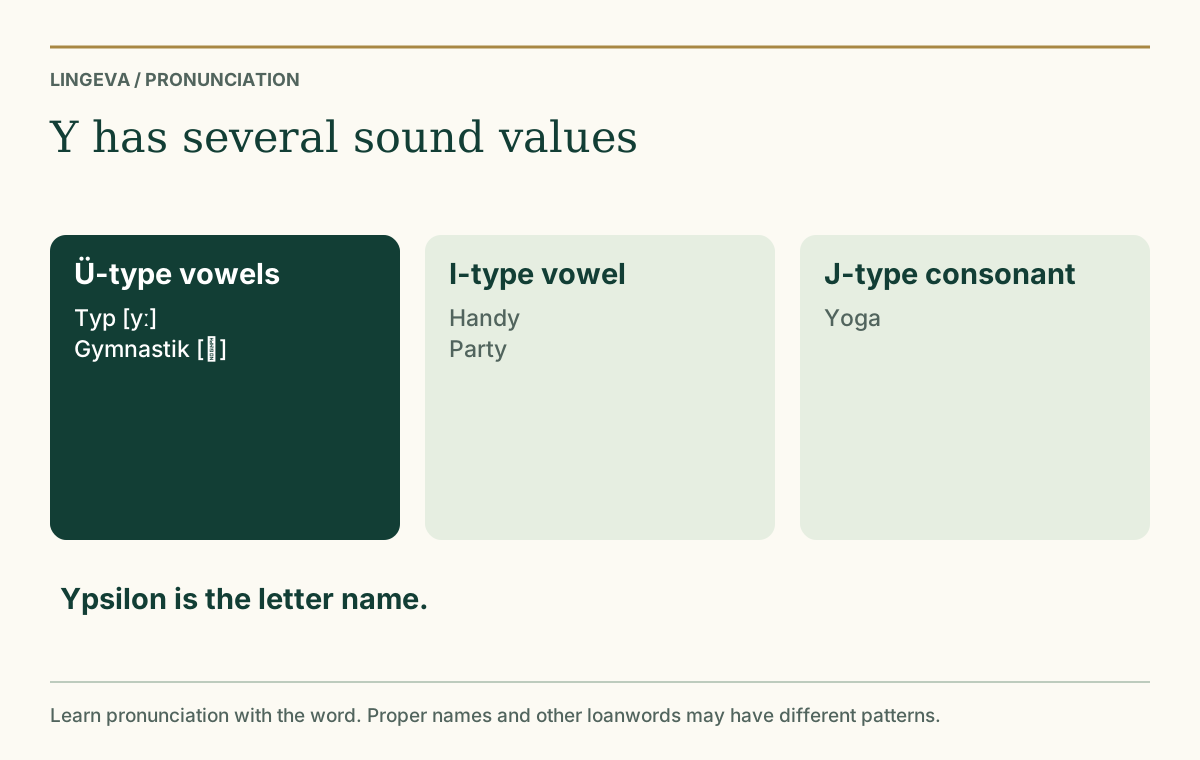
Typ uses long [yː] in the German model here. Gymnastik and System contain short [ʏ]. Party and Handy end with an I-type vowel. Yoga normally begins with the consonant [j], similar to the start of English yes.
The table is a selection of word models. It is not a rule that predicts every personal name, place name or new borrowing. Word history can help you remember a pronunciation, but it does not replace checking the actual German word.
| Word | Target position | Sound value |
|---|---|---|
| Typ | y in the stem | [yː] |
| Gymnastik | y in the first syllable | [ʏ] |
| System | y in the first syllable | [ʏ] |
| Party | final y | I-type vowel |
| Handy | final y | I-type vowel |
| Yoga | initial y | [j] |
Listen to the whole word
Start with Typ, Gymnastik and Yoga while the transcripts are closed. Note the target vowel or initial consonant you hear. Then open the word and match it to the table.
Compare Party and Handy next. Use them in short messages so the pronunciation stays connected to a real meaning. A written y at the end of a word is not automatically an instruction to produce Ü.
German audio
Check an unfamiliar pronunciation
Look up the full dictionary entry and its transcription or recording. Check whether the model describes German use or another language. Proper names can have their own established pronunciations.
When the entry gives several variants, keep any regional or usage labels with them. A German loanword pronunciation is not wrong simply because it differs from the source-language model.
Sort the models by their sound
Make three small groups: Ü-type, I-type and J-type. Sort the recorded words, then say them without looking at the group headings. Check each new word before adding it.
Finish with Mein Handy liegt hier or Wir machen heute Yoga. Keep the target sound when you move from a single word into a complete message.
Check your understanding
Try each task before opening its answer and explanation. Open questions show one possible answer.
Does the name Ypsilon fix the pronunciation of y in every German word?
Check answer
No. Learn the sound value in the whole word.
A letter name and a word sound serve different purposes.
Which sound area fits Typ in the model: Ü, I or J?
Check answer
Ü; specifically long [yː].
The written letter represents a rounded vowel in this word.
Which sound area fits the end of Handy?
Check answer
I.
The model does not end with an Ü vowel.
Which consonant begins Yoga in the model?
Check answer
[j].
It is a consonant value of the written letter, not the letter name.
What does IPA [y] represent?
Check answer
A rounded front vowel.
It does not represent the English letter name why.
Can this small table safely predict every proper name?
Check answer
No. Check unfamiliar names and loanwords individually.
The table supplies examples, not a universal spelling algorithm.
Listen to the recording. Which model word is in the transcript?
Check answer
Handy
Then compare its final sound with the other word groups.
Listen to the recording. Which model word is in the transcript?
Check answer
Yoga
Pay attention to the initial consonant when repeating it.
Frequently asked questions
Are all words with y pronounced exactly as in their source language?
No. Established German usage can differ. Check the German entry and any listed variants.
Does this replace the alphabet guide?
It adds a different skill: the alphabet guide practises the letter name; this lesson practises sound values inside words.