
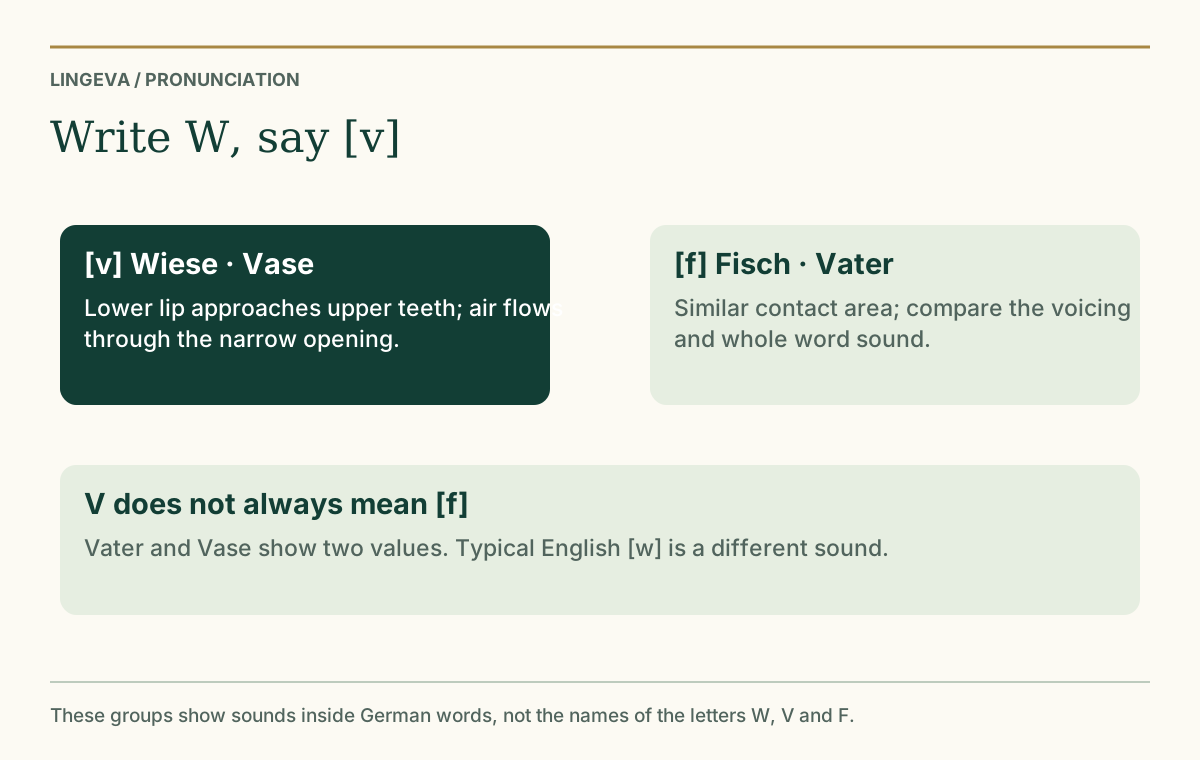
Use the lower lip and upper teeth
For [v] in Wasser, bring the lower lip toward the upper front teeth to create a narrow passage for the air. This is different from rounding the lips into the glide commonly used for English w.
Connect the sound directly to a vowel, then say a familiar German word. You do not need to press the teeth hard into the lip. Use a comfortable position and compare the whole word with the recording.
Compare the word starts
Fisch begins with [f] and Wiese with [v] in the model. Both are formed in the lip-and-teeth area; their voicing and overall sound differ. The amount of voicing can vary in connected speech.
Vater begins with [f], while Vase begins with [v] in the ordinary German models used here. Do not turn one example into a rule that every written v must have the same sound. Learn unfamiliar v-words individually.
| Word | Written start | Sound in the model |
|---|---|---|
| Wasser | w | [v] |
| Wind | w | [v] |
| Fisch | f | [f] |
| Vater | v | [f] |
| Vase | v | [v] |
Listen before reading the spelling
Play each word while its transcript is closed. Listen again for the beginning, then compare the written word with what you heard. The recordings provide German models rather than a sequence of letter names.
If English w is familiar to you, compare a familiar English word from your own speech with the German model. Then return to the complete German word so the comparison does not become an extra sound added before it.
German audio
Keep the sound in a complete message
Begin with warmes Wasser, then use Ich hätte gern warmes Wasser. A clear individual word is a starting point; the target should remain understandable in a normal short request.
Try Der Wind weht von Westen. The repeated starts give you practice inside a meaningful sentence. Speed alone is not the success criterion: a listener should still recognise the words.
Choose the relevant correction
If German w keeps sounding like English w, check whether you are using the lip-and-teeth contact. If Fisch and Wiese start the same way in your speech, compare the audible features of the full models at a similar pace.
For a new word with v, save the dictionary’s word pronunciation with its meaning. The pronunciation of Vater is useful knowledge about Vater, not a complete rule for all names and borrowed words.
Check your understanding
Try each task before opening its answer and explanation. Open questions show one possible answer.
Where is [v] in Wasser formed in this model?
Check answer
At the lower lip and upper front teeth.
That production differs from typical English w.
Which sound starts Fisch in the model?
Check answer
[f]
The letter f has its familiar value in this word.
Which sound starts Vase in the model?
Check answer
[v]
Written v has a different value here from the v in Vater.
Does Vater begin with [f] or [v] in this model?
Check answer
[f]
Learn this pronunciation with the individual word.
Are We and Vau instructions for the start of every w-/v-word?
Check answer
No. They are letter names.
Spelling aloud and pronouncing a word are different tasks.
Should you press your teeth hard into the lower lip?
Check answer
No. Use a comfortable narrow passage for the airflow.
Compare the resulting sound with the natural model.
Listen to the recording. Which model word is in the transcript?
Check answer
Wasser
Focus on its start when you repeat it.
Listen to the recording. Which model word is in the transcript?
Check answer
Vase
Compare its beginning with Vater afterward.
Frequently asked questions
Is German w the same as the name of English V?
English letter-name comparisons can be a memory aid, but practise the German sound inside a real word rather than adding a whole letter name.
Is every German v pronounced like f?
No. Vater and Vase illustrate different values. Check the unfamiliar word and its established German use.