
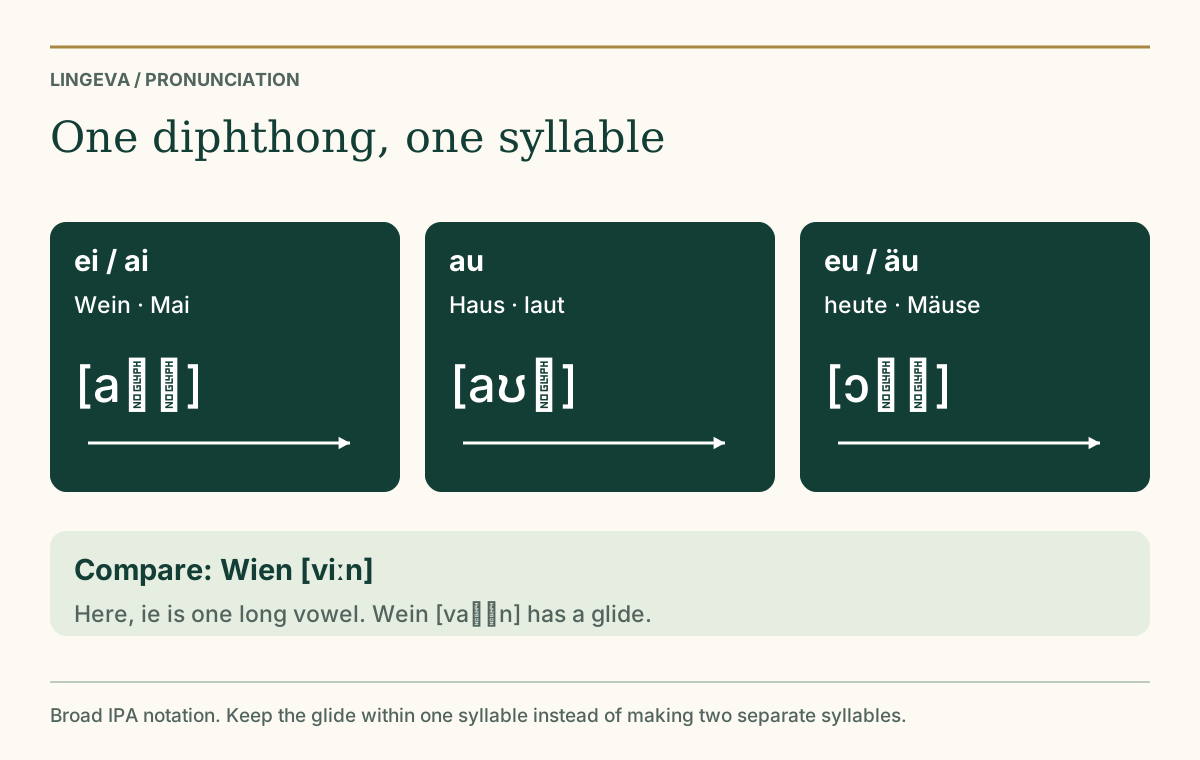
Keep the movement inside one syllable
In Haus, the articulation moves from the beginning of au toward its second vowel position. Keep the movement connected. Breaking it into two separate syllables produces a different pattern.
The symbols [aɪ̯], [aʊ̯] and [ɔʏ̯] are broad learning transcriptions. More detailed phonetic accounts can describe the endpoints differently. Use the German word recording, the glide and the single-syllable structure as your practical targets.
| Spelling | Broad notation | Example |
|---|---|---|
| ei / ai | [aɪ̯] | Wein / Mai |
| au | [aʊ̯] | Haus |
| eu / äu | [ɔʏ̯] | heute / Mäuse |
| ie | [iː] in this example | Wien: a long single vowel |
Learn ei and ie separately
Compare Wein [vaɪ̯n] and Wien [viːn]. Each word has one syllable in this model. The vowel difference distinguishes the words. Saying the letter names E and I separately does not produce the target sound in Wein.
Practise the individual words, then use Der Wein ist hier or Wir fahren nach Wien. Those complete sentences change more than the target vowel, so do not call them minimal-pair sentences.
Listen to the three glide patterns
Start with the separate Wein and Wien recordings while the transcripts are closed. Then sort Haus, heute, Mai and Mäuse by their vowel pattern. Focus on the vowel rather than the total recording length.
In these familiar word models, eu and äu share a sound pattern. A spelling difference can reflect a word family, as in Maus → Mäuse. It does not create a fourth basic diphthong category.
German audio
Glide, connect and use
Choose one word and say it slowly but continuously. Avoid a pause in the middle of the glide. Return to a comfortable pace after you can keep the word connected.
Make a short message such as Heute bleibe ich zu Hause. Keep both heute and Hause understandable in the whole sentence. An exaggerated glide that adds extra syllables is not the goal.
Check unfamiliar words as whole words
The table gives useful patterns in familiar German vocabulary. Names, borrowed forms and letter sequences across word-part boundaries may need a dictionary check.
Record the meaning, stressed syllable and an audio model with a new word. Spelling supports the learning process, but it does not settle every pronunciation question.
Check your understanding
Try each task before opening its answer and explanation. Open questions show one possible answer.
How many syllables does Haus have in this model?
Check answer
One.
The au glide stays inside that syllable.
Which pattern represents a long single vowel here: ei or ie in Wien?
Check answer
ie in Wien
The word model uses [iː].
Match heute to [aɪ̯], [aʊ̯] or [ɔʏ̯].
Check answer
[ɔʏ̯]
The eu pattern has this broad transcription here.
Which spelling represents the glide in Haus?
Check answer
au
The two letters belong to one syllable in this word.
Does äu in Mäuse form a fourth category separate from eu?
Check answer
No. The two spellings share the glide in these word models.
Spelling and sound categories are different levels.
Are Der Wein ist hier and Wir fahren nach Wien complete minimal-pair sentences?
Check answer
No. Several words change.
Begin a controlled sound comparison with the individual words.
Listen to the single word. Did you hear Wein or Wien?
Check answer
Wein
The target uses a glide rather than the long single vowel.
Listen to the single word. Did you hear Wein or Wien?
Check answer
Wien
The target uses the long single vowel [iː].
Frequently asked questions
Do two written vowels always make a diphthong?
No. Ie in Wien represents a long single vowel here. Other sequences can cross syllable or word-part boundaries.
Should both parts be pronounced as separate stressed syllables?
No. Practise a connected movement inside the same syllable.