
A trait describes a pattern; a state describes the moment
Mira ist geduldig. presents patience as a characteristic. Mira ist heute müde. describes how she feels today. The verb sein works in both sentences, so it does not decide whether the adjective names a lasting trait. Meaning and context do that work.
Personality descriptions are often generalizations. Make them more precise with a situation or a repeated action: Mira ist beim Erklären geduldig. Sie beantwortet meine Fragen auch beim dritten Mal ruhig. This gives the reader a reason for the adjective. It does not claim that Mira behaves the same way everywhere.
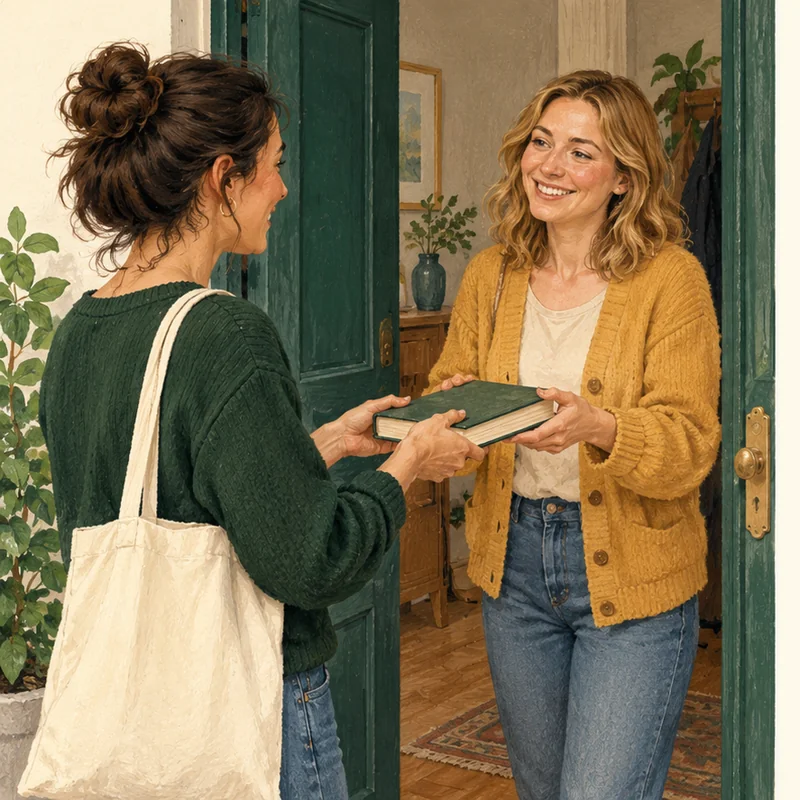
zuverlässig
She returns the borrowed book on the agreed day.

ordentlich
He sorts papers and keeps his workspace organized.
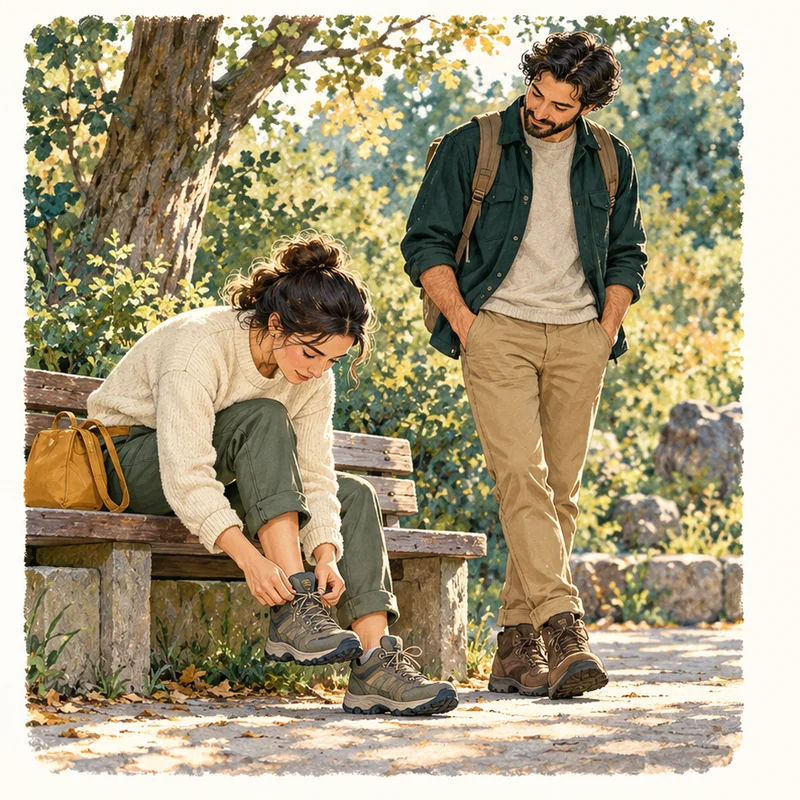
geduldig
He waits without rushing his companion while she ties her shoe.

neugierig
She examines an unfamiliar plant to learn more.

großzügig
She willingly shares her apples with a neighbor.

schüchtern
She says that she usually speaks little when she first joins an unfamiliar group.
These are fictional behavior examples. Use the stated context rather than judging a person from their appearance.
Six German personality adjectives with useful evidence
| Adjective | Meaning here | Original example |
|---|---|---|
| zuverlässig | reliable; someone follows through | Nora hält ihre Zusagen. Auf sie kann ich mich verlassen. |
| geduldig | patient when waiting or dealing with difficulty | Amir erklärt die Regel noch einmal, ohne mich zu drängen. |
| neugierig | curious; wanting to find something out | Linh möchte verstehen, wie die kleine Maschine funktioniert. |
| großzügig | generous in giving or sharing | Ben teilt seine Materialien gern mit der ganzen Gruppe. |
| ordentlich | tidy or organized in the sense used here | Eva legt die Werkzeuge nach der Arbeit an ihren Platz. |
| schüchtern | shy or inhibited around other people | In neuen Gruppen ist Jo zunächst schüchtern und spricht erst später mehr. |
These are selected senses. Großzügig can also describe a tolerant attitude or a spacious layout. Ordentlich has several further uses. In this guide, choose them from the behavior described in the table. The linked Duden entries give the wider meanings.
Choose the adjective that the example actually supports
Being punctual can support a description as zuverlässig, but reliability includes more than arriving on time. A person who arrives early and repeatedly forgets agreed tasks is not automatically reliable. Name the relevant commitment: Sie bringt die Unterlagen immer zum vereinbarten Termin.
Neugierig can sound positive when someone wants to learn. A question about a private matter may be experienced differently. Compare Er ist neugierig auf neue Ideen with Diese Frage ist mir zu privat. Explain the situation rather than assuming that one English equivalent captures every use.
A quiet person is not necessarily shy. They may be concentrating or prefer listening. Use schüchtern when the description supports that meaning, or stay with the observation: Sie hat in der Runde wenig gesagt. This sentence leaves the reason open.
Build a description with a reason and a limit
Start with Person + ist + Adjektiv: Paul ist zuverlässig. The adjective has no ending in this position. Add a concrete example as a separate sentence: Er gibt geliehene Sachen zum vereinbarten Termin zurück. You now have a useful two-sentence description.
An adjective before a noun has an ending: eine geduldige Person, ein zuverlässiger Freund. For the full pattern, use the adjective endings guide. You can also limit a judgment: Bei gemeinsamen Projekten erlebe ich sie als zuverlässig. That describes your experience in a named setting.
Keep similar-word questions with their existing lessons. The guide to character and social vocabulary explains distinctions such as gesellig and sozial; the description guide covers sensibel. A longer adjective list is less useful than choosing one word for a clear reason.
Read three fictional profiles without overinterpreting them
Nora: Sie sagt rechtzeitig ab, wenn sie eine Zusage nicht einhalten kann. Geliehene Bücher bringt sie wie vereinbart zurück. Reliability is a supported description. There is no information about whether her room is tidy.
Amir: Beim Basteln erklärt er einen Schritt mehrfach. Er lässt anderen Zeit zum Ausprobieren. The scene supports patience. It does not establish that he gives away possessions or enjoys parties.
Jo: Jo beschreibt sich selbst als schüchtern in neuen Gruppen. Bei vertrauten Menschen erzählt Jo gern Geschichten. Both statements can be true. A trait can depend on the social setting; avoid turning one adjective into an entire invented biography.
Eight tasks: choose a word and explain your choice
Which adjective fits keeping promises: ordentlich or zuverlässig?
Answer and reason
Zuverlässig. The cue concerns commitments, not tidiness.
Amir gives another explanation and allows time to try again. Choose the best table adjective.
Answer and reason
Geduldig. His behavior shows patience with the learning process.
Does a silent photograph prove that someone is schüchtern?
Answer and reason
No. A photograph does not establish the person's experience or a repeated pattern. Describe the visible action or obtain more context.
Use zuverlässig in its basic form after ist: Paul ist ____.
Answer and reason
Paul ist zuverlässig. After ist, this predicative adjective stays unchanged.
Choose the table adjective: Eva sorts tools and puts each one back after use.
Answer and reason
Ordentlich fits the organization described. It does not establish every other sense of the word.
Ben willingly shares his materials. Is großzügig or neugierig the closer fit?
Answer and reason
Großzügig fits sharing. Neugierig would need a cue about wanting to know or discover something.
Is Mira ist heute müde enough to conclude that tiredness is a stable personality trait?
Answer and reason
No. Heute locates the state today; the sentence gives no lasting character description.
Make Nora ist zuverlässig more specific with evidence from her profile.
One possible answer and reason
Nora ist zuverlässig. Sie bringt geliehene Bücher wie vereinbart zurück. The second sentence supplies an action that supports the first.
Describe one fictional person in three sentences
Choose two adjectives from memory. Invent one ordinary action that supports each choice, then add a setting: Beim gemeinsamen Kochen ist Alex geduldig. Alex erklärt neue Schritte ruhig. Beim Aufräumen ist Alex ordentlich. Check whether each adjective has evidence. Remove any label that only comes from appearance.
On the next attempt, change the behavior and choose the adjective again. This practises meaning instead of memorizing a fixed personal profile. Keep the full sentences with your vocabulary notes so you can recall both the word and the reason for using it.
Questions about this topic
How do I say personality traits in German?
Charaktereigenschaften is a useful term. You can describe a person with Sie ist zuverlässig or Er ist geduldig, then give a concrete behavior example.
Do personality adjectives take endings after ist?
In a sentence such as Nora ist zuverlässig, the adjective has no ending. Before a noun, an ending is needed, as in eine zuverlässige Person.
Does ruhig mean schüchtern?
Not automatically. Quiet behavior can have many causes. Schüchtern describes shyness or inhibition; use it only when the context supports that meaning.
Sources and further learning
Source links checked: .
Use this in your German practice
Try the examples and answer checks on this page. For a wider routine, explore Lingeva’s grammar, vocabulary and speaking practice. Available app features and plan allowances are explained on the plan page.