
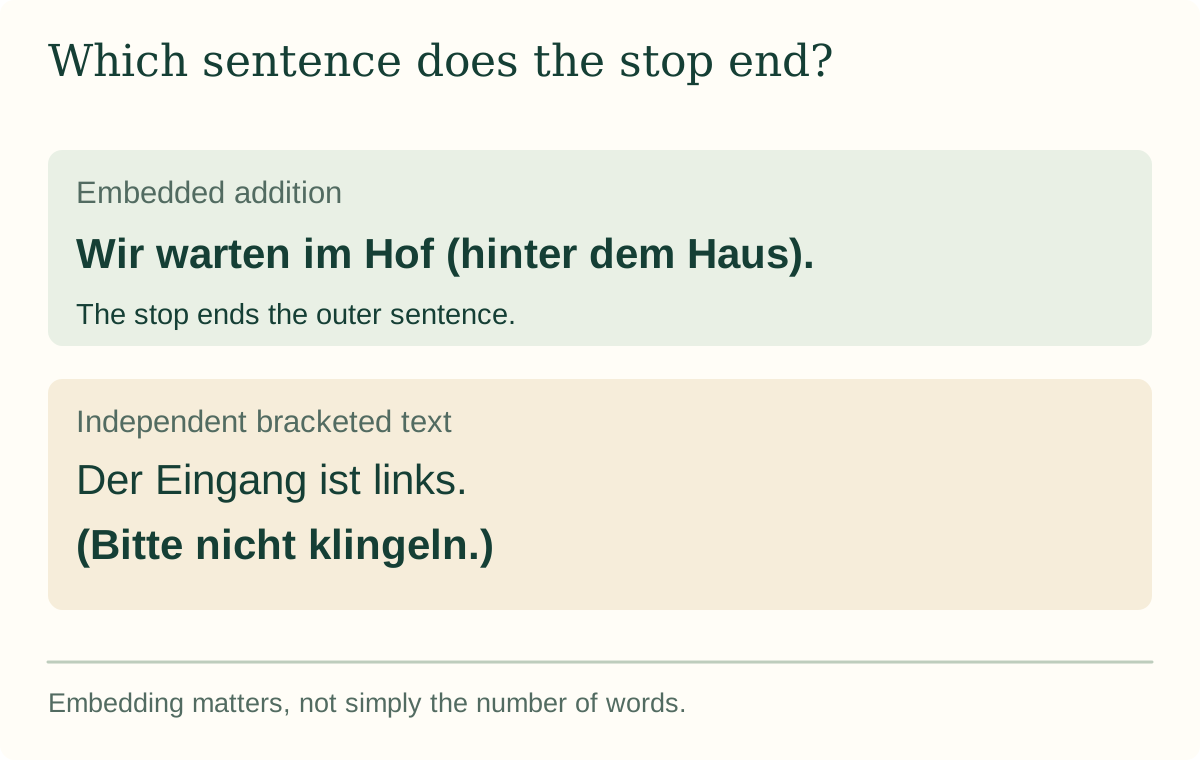
An addition belongs to the surrounding sentence
A parenthetical addition can contain a word, a phrase or even a clause-like comment. The brackets mark it as supplementary information. The sentence outside retains its own structure.
Wir warten im Hof (hinter dem alten Haus).
The full stop ends Wir warten im Hof and comes after the bracket.
Der Bus kommt (so sagt die Anzeige) in fünf Minuten.
The comment is an embedded addition, not a separate new sentence.
An independent sentence goes entirely inside brackets
An independent bracketed text starts with a capital letter and takes its ending punctuation before the closing bracket. This can be a full stop, question mark or exclamation mark.
| Construction | Example | Position of ending punctuation |
|---|---|---|
| Embedded addition | Wir warten im Hof (hinter dem alten Haus). | The surrounding sentence’s full stop is outside. |
| Independent bracketed text | Wir warten im Hof. (Bitte komm dazu.) | The bracketed text’s full stop is inside. |
Der Eingang ist links. (Bitte nicht klingeln.)
The first sentence is already complete. The independent request is entirely bracketed.
Der Kurs beginnt morgen. (Hast du dein Heft schon eingepackt?)
The question is a separate bracketed text, so its question mark stays inside.
Identify what a question mark or exclamation mark belongs to
First ask whether the mark applies to the bracketed text or the whole sentence. A questioning or emphatic addition can retain its own question mark or exclamation mark. The outer sentence still receives its appropriate ending.
Bist du morgen da (gegen neun Uhr)?
The entire utterance is a question. The question mark is outside.
Die Tür ist offen (war das beabsichtigt?).
The addition is a question. Its question mark is inside; the outer statement takes its full stop afterwards.
Lege den Ausweis (bitte nicht die Kopie!) auf den Tisch.
The emphatic addition has an exclamation mark inside. The main sentence continues afterwards.
Required commas remain outside the brackets
An insertion does not cancel the boundaries of its surrounding sentence. Temporarily remove the addition and read the remaining structure. Wherever that structure requires a comma, the comma must remain visible with the addition too.
This test checks grammar, not the importance of the information. The bracketed material can still matter for a practical decision. Do not assume it can be deleted from the meaning when copying the message.
Ich merke (leider), dass das Ticket fehlt.
Without the addition, the sentence is Ich merke, dass das Ticket fehlt. The comma therefore comes after the closing bracket.
Does the bracketed text start with a capital?
An addition embedded in a sentence normally starts in lower case unless another capitalization rule applies. Names and nouns, for example, retain their capitals. An independent bracketed sentence instead starts with a capital.
Der Bus kommt (so sagt die Anzeige) in fünf Minuten.
So is lower-case here because the addition is embedded in the sentence.
Der Bus kommt (laut Anzeige) in fünf Minuten.
Anzeige remains capitalized as a noun; the addition still starts with lower-case laut.
Check a bracketed passage in three steps
First read the text without the brackets and their contents. Then identify the boundary of the surrounding sentence. Finally check whether the addition itself contains a question, exclamation or independent sentence.
Explain a correction using categories such as embedded addition, outer question or independent bracketed text. These make the solution traceable. Neither word count nor the presence of a finite verb inside the brackets determines the punctuation by itself.
Check your understanding
Try each task before opening the model answer. Open tasks can have other valid answers.
Add the full stop: Wir warten im Hof (hinter dem alten Haus)
Answer and explanation
Wir warten im Hof (hinter dem alten Haus).
The addition is embedded in the statement. The surrounding sentence’s full stop is outside.
The request is independent bracketed text. Add its missing full stop: Der Eingang ist links. (Bitte nicht klingeln)
Answer and explanation
Der Eingang ist links. (Bitte nicht klingeln.)
The independent bracketed text takes its full stop inside.
The whole utterance is a question. Add the question mark: Bist du morgen da (gegen neun Uhr)
Answer and explanation
Bist du morgen da (gegen neun Uhr)?
The question mark belongs to the outer sentence.
Only the addition is a question. Add its question mark and the outer full stop: Die Tür ist offen (war das beabsichtigt)
Answer and explanation
Die Tür ist offen (war das beabsichtigt?).
The question mark is inside the addition; the full stop ends the surrounding statement.
Add an exclamation mark inside and a full stop at the end: Lege den Ausweis (bitte nicht die Kopie) auf den Tisch
Answer and explanation
Lege den Ausweis (bitte nicht die Kopie!) auf den Tisch.
The emphatic side comment and outer sentence each receive the appropriate punctuation.
Insert the required comma: Ich merke (leider) dass das Ticket fehlt.
Answer and explanation
Ich merke (leider), dass das Ticket fehlt.
Without the addition, Ich merke, dass das Ticket fehlt remains. The dass boundary still requires a comma.
The addition is inside the sentence. Choose so or So: Der Bus kommt (__ sagt die Anzeige) in fünf Minuten.
Answer and explanation
so
The embedded addition starts in lower case. There is no other reason to capitalize so.
Add this as independent bracketed text: Der Bus kommt später. [bitte warte im Gebäude]
Answer and explanation
Der Bus kommt später. (Bitte warte im Gebäude.)
The independent request starts with a capital and takes its full stop inside the brackets.
Frequently asked questions
Does a full stop always go outside German brackets?
No. An independent bracketed sentence takes its full stop inside. With an embedded addition, the final full stop belongs to the surrounding sentence and goes outside.
Can punctuation appear both before and after a closing bracket?
Yes. An addition’s question mark or exclamation mark can be inside while the outer statement receives its full stop afterwards. The marks then perform different jobs.
Is every complete clause in brackets independent?
No. Even a clause-like comment can be inserted into another sentence. Check how it is embedded and where the outer sentence ends.