
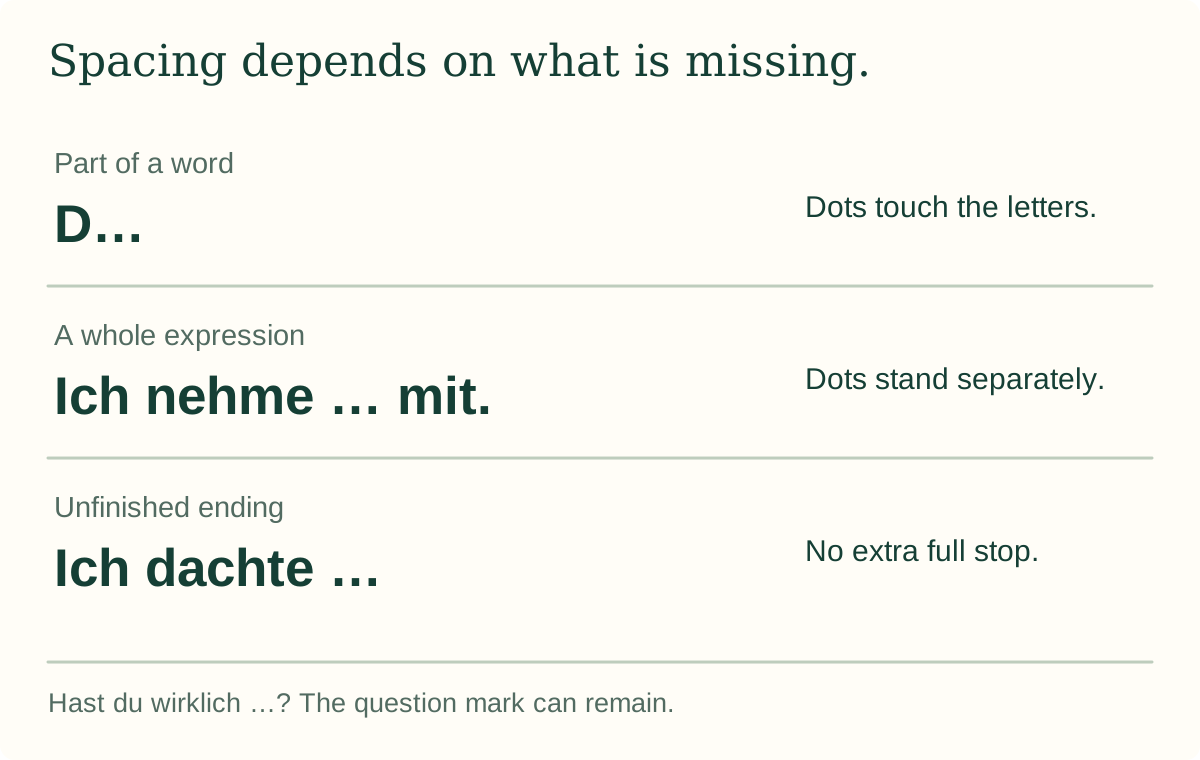
What is missing: letters, words or the rest of a sentence?
First compare two types of gap. In an interrupted word, the remaining letters and the omission belong together. If a whole word or a longer continuation is missing, the ellipsis stands separately.
Das war doch dieser D… aus unserem Kurs.
The name is cut off within the word. There is no space between D and the dots.
Ich wollte dir noch … ach, das erzähle ich später.
The continuation is left unfinished. The dots do not touch the preceding word.
Where do the spaces go?
Read the words immediately before and after the dots. In Ich nehme … mit., there is a gap for an omitted object. The dots stand separately; the final full stop belongs to the completed sentence ending in mit.
When drafting, mentally fill the gap: Ich nehme mein Heft mit. Then remove only the omitted content. This helps you see why the remaining words do not attach to the ellipsis.
| Example | Type of gap | Spacing |
|---|---|---|
| D… | Part of a word is missing. | No space between D and … |
| Ich nehme … mit. | A whole expression is missing. | Spaces before and after … |
| Vielleicht später … | The utterance is left unfinished. | A space before … |
Do you need another full stop afterwards?
When the ellipsis comes at the end, do not add another full stop. A question mark or exclamation mark can still indicate the kind of utterance intended. An unfinished thought therefore does not need four dots.
Ich hatte gehofft …
The continuation is left unfinished; another full stop is unnecessary here.
Hast du wirklich …?
The question mark is retained.
Wenn das noch einmal passiert …!
The exclamation mark indicates an emphatic interruption here.
A required comma stays in place
Omitting content does not remove a grammatical boundary. Check the sentence structure independently of the dots. If a comma belongs after the interrupted unit, it is still required there.
Wenn du nur wüsstest …, würdest du anders reagieren.
The preceding wenn unit is separated from the main clause. A comma therefore follows the ellipsis.
How do you shorten a quotation?
When you omit material inside a quotation, mark the omission with square brackets: […]. This identifies the shortening as an intervention in the quoted text. An ordinary unfinished message does not need these brackets.
The source quotation below is an original example. Its shortened version removes only the time expression. It changes neither the meeting place nor the statement that a meeting will happen.
Ausgangssatz: „Wir treffen uns am Donnerstag um acht Uhr im Innenhof.“
This is the complete original example sentence.
Gekürzt: „Wir treffen uns […] im Innenhof.“
The removed time expression is replaced with […].
Check a message before sending it
First identify whether letters, a whole expression or the continuation of an utterance are missing. Then check the spaces. Finally review the punctuation: is the full stop really needed, or does the question still need its question mark?
Do not confuse an ellipsis with an abbreviation point. Nr. means Nummer; the number following it is not an interrupted word. The related guides below explain written abbreviations and quotation marks.
Check your understanding
Try each task before opening the model answer. Open tasks can have other valid answers.
A name is cut off after the letter D. Write D followed by an ellipsis.
Answer and explanation
D…
The dots touch the letter because part of the word is missing.
Other valid answers: D...
A whole object is omitted: Ich nehme [omission] mit. Insert the three dots with suitable spaces.
Answer and explanation
Ich nehme … mit.
An omitted expression does not attach to nehme or mit.
Other valid answers: Ich nehme ... mit.
The utterance remains unfinished: Ich dachte [omission]. Write it without an unnecessary final full stop.
Answer and explanation
Ich dachte …
The ellipsis marks the unfinished ending. Do not add a fourth dot.
Other valid answers: Ich dachte ...
A question breaks off: Hast du wirklich [omission]? Add the ellipsis and question mark.
Answer and explanation
Hast du wirklich …?
The question mark remains after the ellipsis.
Other valid answers: Hast du wirklich ...?
An emphatic utterance breaks off: Wenn das noch einmal passiert [omission]! Add the punctuation.
Answer and explanation
Wenn das noch einmal passiert …!
An interrupted utterance can still end with an exclamation mark.
Other valid answers: Wenn das noch einmal passiert ...!
Insert the missing comma: Wenn du nur wüsstest … würdest du anders reagieren.
Answer and explanation
Wenn du nur wüsstest …, würdest du anders reagieren.
The boundary between the preceding wenn unit and the main clause still needs to be marked.
Remove only am Donnerstag um acht Uhr from this quotation: „Wir treffen uns am Donnerstag um acht Uhr im Innenhof.“
Answer and explanation
„Wir treffen uns […] im Innenhof.“
The square brackets identify the omission within the quotation. The meeting place stays the same.
What is the function of the point after Nr. in „Bitte lies Nr. 8.“?
Answer and explanation
It belongs to the abbreviation Nr., meaning Nummer.
An abbreviation point does not mark an omitted part of the sentence here. The final point after 8 ends the sentence.
Frequently asked questions
Must there always be a space before an ellipsis?
No. If only part of a word is missing, the dots touch the remaining letters. If whole words or a continuation are omitted, the dots stand separately.
Can a question mark follow an ellipsis in German?
Yes. A question mark can follow the ellipsis directly. An additional ordinary final full stop is omitted.
What does […] mean in a quotation?
The square brackets mark the omission of part of the quoted text. Check that the shortened quotation still represents the original statement accurately.