
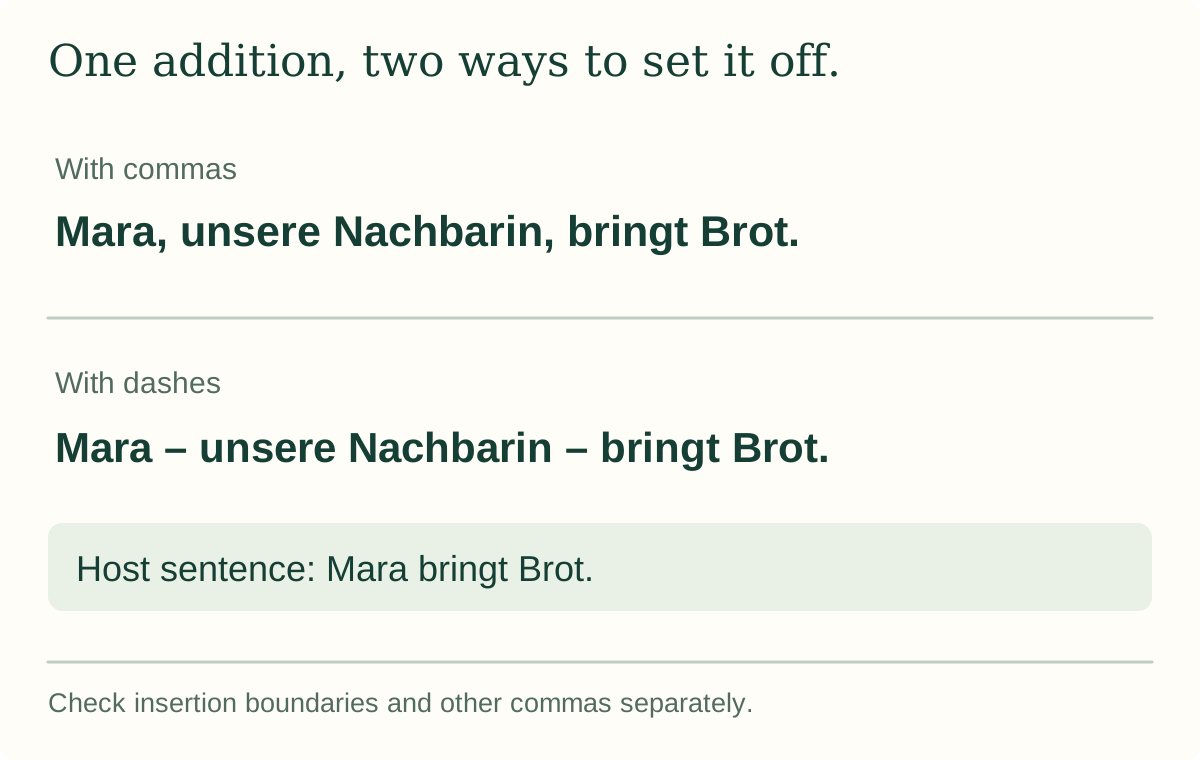
The same addition, presented differently
An appositional description can be set off with commas or dashes. Dashes visibly interrupt the ongoing construction. This choice concerns how information is presented; it does not automatically make the other grammatically possible version wrong.
Mara, unsere Nachbarin, bringt Brot.
The commas mark the additional description unsere Nachbarin.
Mara – unsere Nachbarin – bringt Brot.
The dashes highlight the same description as an insertion.
Mark both boundaries inside the sentence
When an insertion begins inside a sentence and the host sentence continues afterwards, use an opening and closing dash. Try reading the host sentence without the insertion.
If the addition is at the end, do not add a second dash before the full stop. In Ich brauche nur eines – Ruhe., one dash introduces the final explanation.
Die Lieferung – sie war für Dienstag angekündigt – kommt erst am Freitag.
Without the insertion, Die Lieferung kommt erst am Freitag remains.
Unser Gast – ein Arzt aus Köln – hilft uns.
The addition describes the subject. Both dashes delimit this extra noun phrase.
When does a comma follow the dash?
The dash belongs to the insertion. At the same time, a comma may mark a boundary in the host sentence. The two marks can therefore appear consecutively when they perform different jobs.
Sie bestätigt – wie angekündigt –, dass der Raum frei ist.
Without the insertion, Sie bestätigt, dass der Raum frei ist remains. The second dash closes the addition; the comma marks the dass boundary.
Questions, exclamations and capitals inside an insertion
An insertion’s question mark or exclamation mark comes before the closing dash. An ordinary full stop does not go there. The outer sentence continues and receives its own appropriate ending.
The inserted addition starts in lower case unless another capitalization rule applies. A name naturally retains its capital. When rereading, do not treat every word following a dash as the start of a new sentence.
Der Termin – war es nicht Freitag? – steht im Kalender.
The question is an insertion. Its question mark is inside, before the second dash.
Distinguish dashes, hyphens and brackets
In Online-Kurs, the short hyphen connects word components without spaces. The longer dash in the insertion shown here is separated from the words by spaces. The two signs do different jobs.
Brackets can also identify supplementary information. That does not mean any commas, dashes and brackets can be exchanged at will. The structure, embedding and intended effect must fit the chosen version.
| Written form | Job in this example | Check |
|---|---|---|
| Online-Kurs | Connect word components | Are you deciding how to write a word? |
| Mara, unsere Nachbarin, bringt Brot. | Mark an addition’s grammatical boundaries | Where does the description begin and end? |
| Mara – unsere Nachbarin – bringt Brot. | Highlight an addition as an interruption | Does the host sentence remain intact outside it? |
Revise a long sentence for readability
Underline the host sentence and mentally bracket off the addition. First check the addition’s two boundaries. Then inspect the other commas, followed by punctuation inside the addition.
If the text contains several nested insertions, another sentence can be clearer. A dash is not a repair mark for an unwieldy construction. Decide which information the reader needs first and which you can explain separately.
Check your understanding
Try each task before opening the model answer. Open tasks can have other valid answers.
Set off the insertion with dashes: Die Lieferung [sie war für Dienstag angekündigt] kommt erst am Freitag.
Answer and explanation
Die Lieferung – sie war für Dienstag angekündigt – kommt erst am Freitag.
The host sentence continues after the addition. Both boundaries are marked.
The addition comes at the end. Add a dash and final full stop: Ich brauche nur eines [Ruhe]
Answer and explanation
Ich brauche nur eines – Ruhe.
At the end of the sentence, the addition is not closed with another dash.
Insert the additional required comma: Sie bestätigt – wie angekündigt – dass der Raum frei ist.
Answer and explanation
Sie bestätigt – wie angekündigt –, dass der Raum frei ist.
The comma before dass is required without the insertion too. It remains after the second dash.
Add a question mark to the inserted question: Der Termin – war es nicht Freitag – steht im Kalender.
Answer and explanation
Der Termin – war es nicht Freitag? – steht im Kalender.
The question mark belongs to the question between the dashes, not to the outer statement.
Set off the extra description with dashes: Unser Gast [ein Arzt aus Köln] hilft uns.
Answer and explanation
Unser Gast – ein Arzt aus Köln – hilft uns.
The description refers to the subject Gast. The host sentence remains Unser Gast hilft uns.
Which sign connects the components of Online-Kurs: a hyphen or a dash?
Answer and explanation
A hyphen.
This is the spelling of a word, not an interruption of an ongoing sentence.
Are both versions possible: „Mara, unsere Nachbarin, bringt Brot“ and „Mara – unsere Nachbarin – bringt Brot“?
Answer and explanation
Yes. The commas delimit the addition; the dashes highlight it as an interruption.
Here the choice concerns organization and effect. The dash version does not make the comma version wrong.
Write your own sentence with a paired insertion. The sentence outside it should remain complete.
Answer and explanation
For example: Wir starten – der Raum ist schon frei – um neun Uhr.
Without the addition, Wir starten um neun Uhr remains. Other suitable sentences marking both insertion boundaries are possible.
Other valid answers: Other grammatically suitable original sentences.
Frequently asked questions
Can I replace every German comma with a dash?
No. First identify the unit the comma separates. Dashes can mark an interruption or addition; they do not replace grammatical comma rules in general.
Why do –, sometimes appear together?
The dash can close an insertion while the following comma marks a required boundary in the host sentence. Each then has a separate job.
Does a dash always need a partner?
Both boundaries are marked for an insertion inside a sentence. An explanation at the end does not take a closing dash. Other functions, such as a change of speaker, also have their own patterns.