
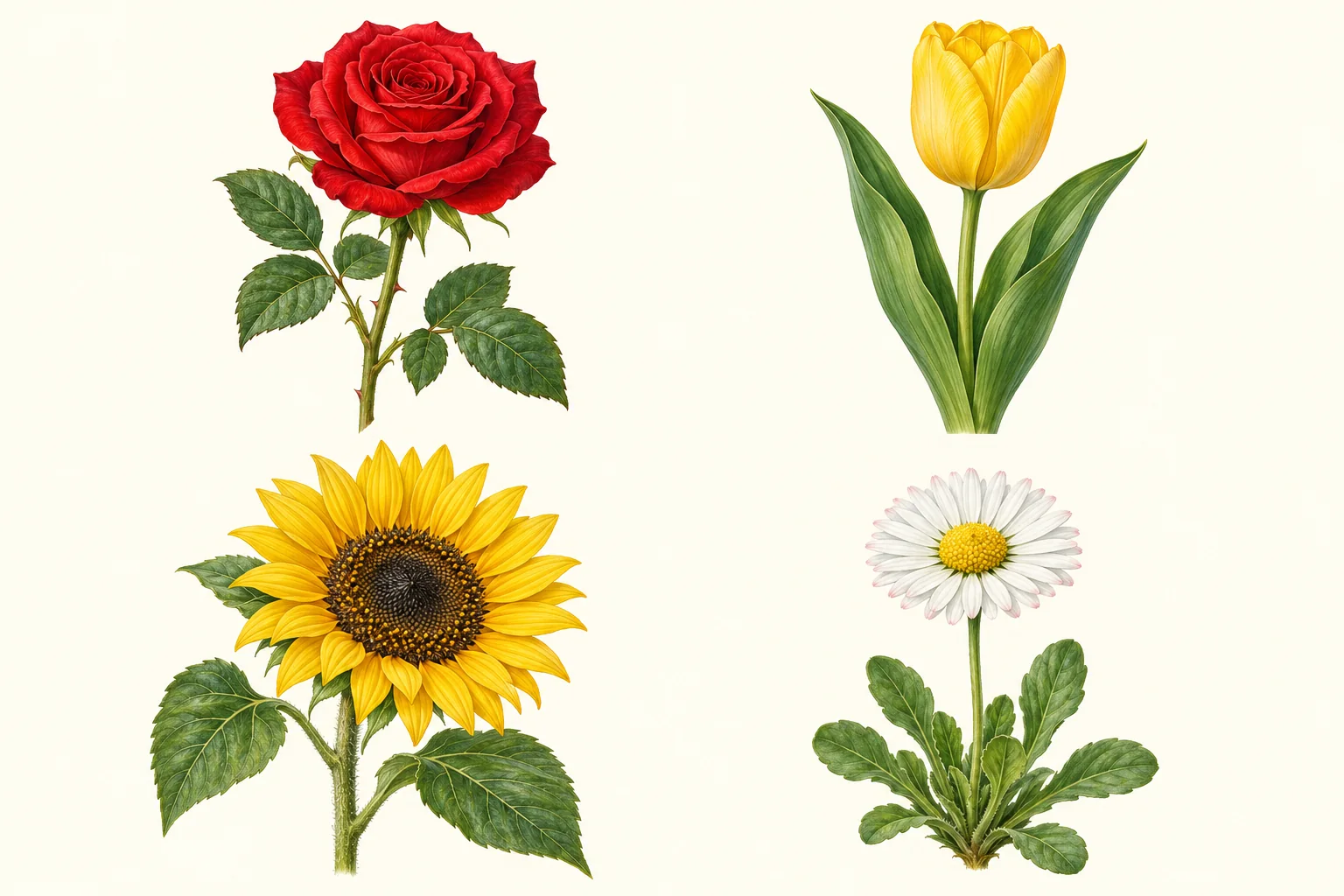
Names, articles and plurals
Read the first two columns aloud together. The plural article is die, even when the singular has der or das. The example or meaning column helps you keep the intended sense.
| German | Plural | English meaning |
|---|---|---|
| die Rose | die Rosen | rose |
| die Tulpe | die Tulpen | tulip |
| die Sonnenblume | die Sonnenblumen | sunflower |
| die Lilie | die Lilien | lily |
| die Nelke | die Nelken | carnation |
| die Orchidee | die Orchideen | orchid |
| die Narzisse | die Narzissen | daffodil |
| das Veilchen | die Veilchen | violet |
| das Gänseblümchen | die Gänseblümchen | daisy |
| die Hyazinthe | die Hyazinthen | hyacinth |
| der Krokus | die Krokusse | crocus |
| der Löwenzahn | die Löwenzähne | dandelion |
Replay a line, transcript and audio files
die Rose. die Rosen.
Open audio file 1die Tulpe. die Tulpen.
Open audio file 2die Sonnenblume. die Sonnenblumen.
Open audio file 3die Lilie. die Lilien.
Open audio file 4die Nelke. die Nelken.
Open audio file 5die Orchidee. die Orchideen.
Open audio file 6die Narzisse. die Narzissen.
Open audio file 7das Veilchen. die Veilchen.
Open audio file 8das Gänseblümchen. die Gänseblümchen.
Open audio file 9die Hyazinthe. die Hyazinthen.
Open audio file 10der Krokus. die Krokusse.
Open audio file 11der Löwenzahn. die Löwenzähne.
Open audio file 12
Name the flower, then say how many
After a number above one, use the plural: fünf Tulpen. You normally do not add an indefinite article: fünf Tulpen, not fünf eine Tulpen. With an accusative object, masculine der changes to einen: Ich nehme einen Krokus.
A bouquet is der Strauß, plural die Sträuße. It can contain several kinds of flower. Ich hätte gern einen Strauß asks for a bouquet; Ich hätte gern fünf Rosen specifies a flower and a number.
An original short exchange
Read both roles. Then cover one speaker and supply a suitable reply. The wording below is a model, not the only possible exchange.
- Kundin
- Ich hätte gern fünf Tulpen.
- Verkäufer
- Welche Farbe möchten Sie?
- Kundin
- Gelb, bitte. Was kosten die fünf zusammen?
- Verkäufer
- In dieser Übung kosten sie zehn Euro.
- Kundin
- Gut, die nehme ich.
Build a different order
Change the flowers to roses, the number to three and the colour to red. Keep the polite frame, but choose the correct plural. Then ask for the total price without assuming the fictional price above applies in a real shop.
Cover the German column and name three flowers from memory. Add one original sentence about where they are. Move from recognition to a complete request before adding more names.
Put it into practice
Try each task before opening the answer. Open questions show one possible model answer.
Give the plural with its article: die Tulpe.
Answer and explanation
die Tulpen
The plural adds -n; the plural article is die.
Complete: Ich hätte gern fünf __ (Rose).
Answer and explanation
Rosen
The number requires the plural.
Order one crocus: Ich nehme __ Krokus.
Answer and explanation
einen
Krokus is masculine and the object of nehmen is accusative.
Give the plural: das Veilchen.
Answer and explanation
die Veilchen
The noun stays unchanged; the article shows the plural.
Ask politely for three yellow tulips.
Answer and explanation
Ich hätte gern drei gelbe Tulpen.
This is one model request. The plural noun follows the number and inflected adjective.
Ask what the whole bouquet costs.
Answer and explanation
Was kostet der Strauß?
Der Strauß is the singular subject, so the verb is kostet.
Questions learners ask
Does Blume mean blossom as well as flower?
Blume usually names the flowering plant or a cut flower. Blüte names the blossom as part of a plant. Use the intended object, rather than treating the two as universal substitutes.
Is Gänseblümchen plural unchanged?
Yes: das Gänseblümchen, die Gänseblümchen. The same unchanged pattern occurs with Veilchen.