
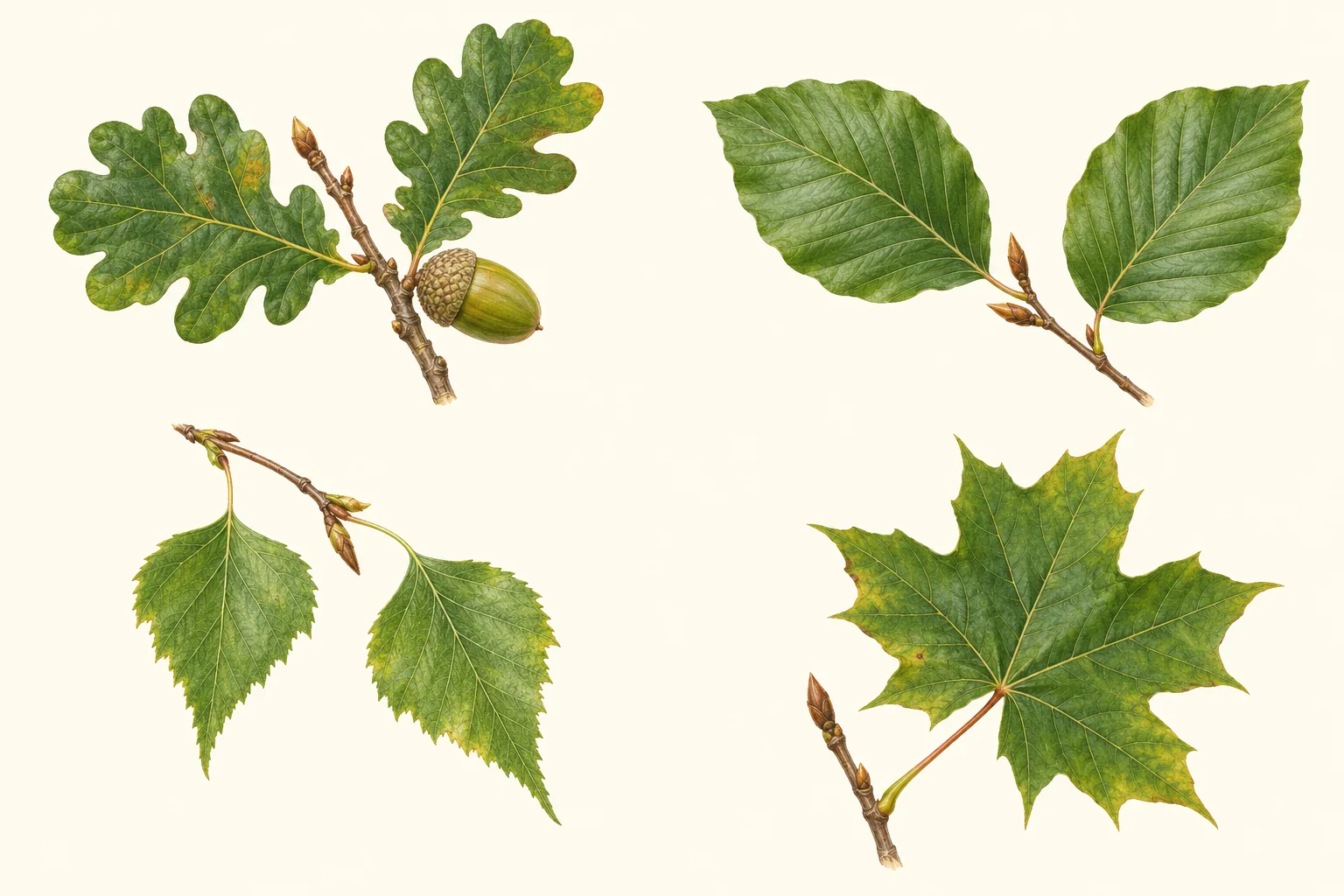
Names, articles and plurals
Read the first two columns aloud together. The plural article is die, even when the singular has der or das. The example or meaning column helps you keep the intended sense.
| German | Plural | English meaning |
|---|---|---|
| die Eiche | die Eichen | oak |
| die Buche | die Buchen | beech |
| die Birke | die Birken | birch |
| der Ahorn | die Ahorne | maple |
| die Tanne | die Tannen | fir |
| die Fichte | die Fichten | spruce |
| die Linde | die Linden | lime / linden tree |
| die Weide | die Weiden | willow; also pasture in another sense |
| die Pappel | die Pappeln | poplar |
| die Kastanie | die Kastanien | chestnut tree or chestnut |
Replay a line, transcript and audio files
die Eiche. die Eichen.
Open audio file 1die Buche. die Buchen.
Open audio file 2die Birke. die Birken.
Open audio file 3der Ahorn. die Ahorne.
Open audio file 4die Tanne. die Tannen.
Open audio file 5die Fichte. die Fichten.
Open audio file 6die Linde. die Linden.
Open audio file 7die Weide. die Weiden.
Open audio file 8die Pappel. die Pappeln.
Open audio file 9die Kastanie. die Kastanien.
Open audio file 10
A place and a destination use different phrases
Wir warten unter der Linde describes a location, so unter has a dative phrase here. Wir stellen die Bank unter die Linde describes the destination of the placement and uses accusative. The choice is about the spatial relationship, not simply whether a person moves.
Some tree names also name their fruit, including Kastanie. In Vor dem Haus steht eine Kastanie, the verb and location make the tree reading clear. If the distinction matters, say Kastanienbaum or describe the intended object.
An original short exchange
Read both roles. Then cover one speaker and supply a suitable reply. The wording below is a model, not the only possible exchange.
- Nora
- Wo treffen wir uns im Park?
- Ben
- Bei der großen Eiche am Eingang.
- Nora
- Steht die neben der Bank?
- Ben
- Ja. Hinter der Bank sind zwei Birken.
- Nora
- Gut, dann warte ich dort auf dich.
Give directions with two landmarks
Choose two trees from the table. Put one in a singular sentence and the other in a plural sentence: Die Linde steht am Eingang. Hinter ihr wachsen drei Birken. The pronoun ihr refers to the feminine Linde.
Then give a meeting instruction with bei: Wir treffen uns bei der Linde. Keep the correct dative article. You do not need to memorise every botanical detail before you can practise this everyday task.
Put it into practice
Try each task before opening the answer. Open questions show one possible model answer.
Give the plural of der Baum.
Answer and explanation
die Bäume
The plural adds an umlaut and -e.
Give the article for Eiche.
Answer and explanation
die Eiche
The tree name is feminine.
Complete: Wir warten unter __ Linde.
Answer and explanation
der
This is a location with a dative feminine noun phrase.
Complete: Zwei Birken __ hinter der Bank. (stehen)
Answer and explanation
stehen
The subject is plural.
Arrange a meeting at the oak.
Answer and explanation
Wir treffen uns bei der Eiche.
Bei takes dative.
Describe three fir trees behind a house.
Answer and explanation
Hinter dem Haus stehen drei Tannen.
This is one model location description; Tanne has plural Tannen.
Questions learners ask
Does Weide always mean willow?
No. It can also mean a pasture. A sentence about a tree or branches helps establish the intended sense.
How do I talk about a meeting point near a tree?
Use a location phrase such as unter der Eiche. For movement to that place, a phrase such as unter die Eiche can describe the destination.