
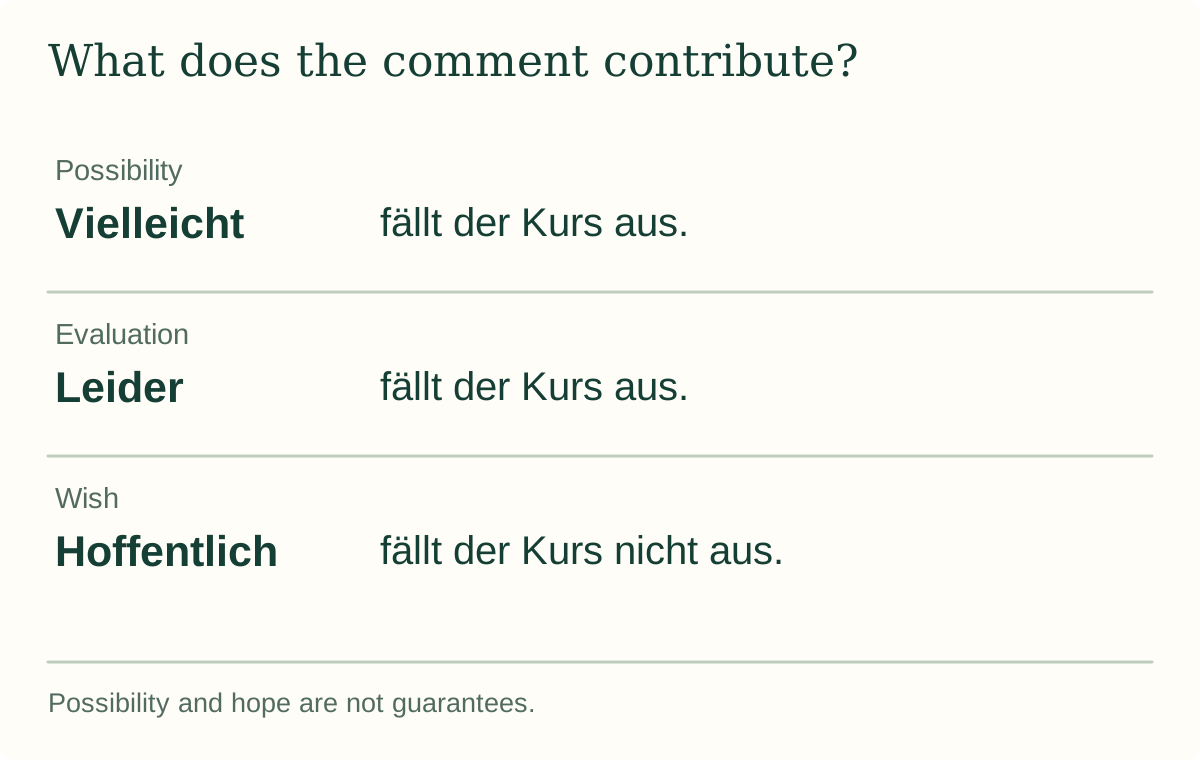
Does the word comment on the statement or describe the action?
In Leider fällt der Kurs aus, leider applies to the state of affairs of the cancellation. It does not describe the way someone performs the course. You can spell out the evaluation: the course is cancelled, and I find that regrettable.
Compare Sie erklärt die Aufgabe ruhig. Here ruhig describes the manner of explaining. The distinction concerns scope; it does not automatically turn every adjective used adverbially into a word belonging to the adverb class.
Leider fällt der Kurs aus.
A comment on the whole state of affairs: the cancellation is regretted.
Sie erklärt die Aufgabe ruhig.
A description of the action: how does she explain it? Calmly.
Distinguish possibility, evaluation and hope
A comment can change whether something is presented as certain, merely considered possible or wished for. Removing the word can therefore produce a different claim.
In the third example below, nicht belongs to the desired state of affairs. Hoffentlich still does not turn the wish into a promise. Do not confuse an attitude towards a statement with confirmation that it will actually happen.
| Sentence | Function of the comment | What is established or left open |
|---|---|---|
| Vielleicht fällt der Kurs aus. | Possibility | The cancellation is not confirmed. |
| Leider fällt der Kurs aus. | Regretful evaluation | The cancellation is presented as a fact here. |
| Hoffentlich fällt der Kurs nicht aus. | Wish | The desired outcome is no cancellation; what actually happens remains open. |
Check scope with a paraphrase
Spell out what the word contributes. In a suitable context, vielleicht can be paraphrased as Es ist möglich, dass …; leider can be expanded as an evaluation such as Ich finde es bedauerlich, dass …. This makes its reference to a state of affairs visible.
These paraphrases explain the meanings in these examples. They are not a mechanical substitution rule for every word any grammar calls a sentence adverb. Specialist descriptions use the term with different scopes; this lesson focuses on commenting uses.
At the start or inside the sentence: check the finite verb
Such a comment can occupy the first constituent position of a statement. The finite verb then follows in second constituent position. This is not the same as the second word: a constituent can contain several words.
A sentence adverb at the start does not automatically require a comma. There is no separating comma after leider in „Leider regnet es.“
Vielleicht kommt Mia mit.
Vielleicht occupies the first constituent position; kommt is the finite verb.
Mia kommt vielleicht mit.
In the intended context, Mia’s coming along remains possible. Position alone does not provide a fixed probability percentage.
Read negation and parenthetical comments carefully
Vielleicht ist der Raum nicht frei presents the room not being available as a possibility. Removing vielleicht turns it into a definite assertion: Der Raum ist nicht frei. This is different information.
A comment can also be explicitly set off as an insertion: Der Raum ist – hoffentlich – frei. This visibly highlights the comment. The neutral Der Raum ist hoffentlich frei. needs no insertion marks. Do not place a pair of commas around every sentence adverb.
Rephrase a message without changing its meaning
First identify the state of affairs and then the attitude towards it. Is it confirmed, possible, regretted or hoped for? Pay particular attention to nicht and words limiting the claim when changing word order.
Finally compare the two complete sentences. If the new version expresses a confirmed cancellation instead of a possibility, the rephrasing has failed in meaning even if its word order is grammatical.
Check your understanding
Try each task before opening the model answer. Open tasks can have other valid answers.
Which message presents the cancellation as a fact and regrets it: „Vielleicht fällt der Kurs aus“ or „Leider fällt der Kurs aus“?
Answer and explanation
Leider fällt der Kurs aus.
Leider evaluates the reported event regretfully; vielleicht presents it only as possible.
Does „Vielleicht fällt der Kurs aus“ confirm that the course is cancelled?
Answer and explanation
No. It reports a possibility.
Removing vielleicht would change the force of the message.
What is wished for in „Hoffentlich fällt der Kurs nicht aus“?
Answer and explanation
That the course will not be cancelled.
Nicht belongs to the desired outcome. Expressing the wish does not confirm that it will come true.
In „Sie erklärt die Aufgabe ruhig“, does ruhig evaluate the whole state of affairs or describe the manner of explaining?
Answer and explanation
The manner of explaining.
Ruhig is an adjective used adverbially to describe the action here, rather than a commenting leider or vielleicht.
Move vielleicht to the start while keeping the meaning of possibility: Mia kommt vielleicht mit.
Answer and explanation
Vielleicht kommt Mia mit.
The finite verb kommt follows the initial constituent vielleicht. The stated context retains the meaning of possibility.
Is a comma automatically needed after leider in „Leider regnet es“?
Answer and explanation
No: Leider regnet es.
A normal sentence adverb placed at the start is not separated by a comma merely because of its word class.
Does „Der Raum ist nicht frei“ retain the uncertainty of „Vielleicht ist der Raum nicht frei“?
Answer and explanation
No. Without vielleicht, the room’s unavailability is stated definitely.
A possible situation and a definite assertion do not have the same meaning.
Write a short message hoping for an answer without guaranteeing it. Use hoffentlich.
Answer and explanation
For example: Hoffentlich bekommen wir heute eine Antwort.
The sentence expresses a wish. It does not predict that an answer will definitely arrive today. Other suitable sentences are possible.
Other valid answers: Other suitable wishes using hoffentlich.
Frequently asked questions
Does vielleicht express a fixed percentage?
No. It marks a possibility. How likely that possibility seems in a particular conversation cannot be read from an unchanging percentage.
Are sentence adverbs and modal particles always the same thing?
Different descriptions classify these terms differently. This lesson treats comments such as leider, vielleicht and hoffentlich. Do not extend their properties to every word that is called a modal particle somewhere.
Must a sentence adverb come first?
No. The uses shown here can also appear inside a sentence. When changing position, check sentence structure and intended scope.