
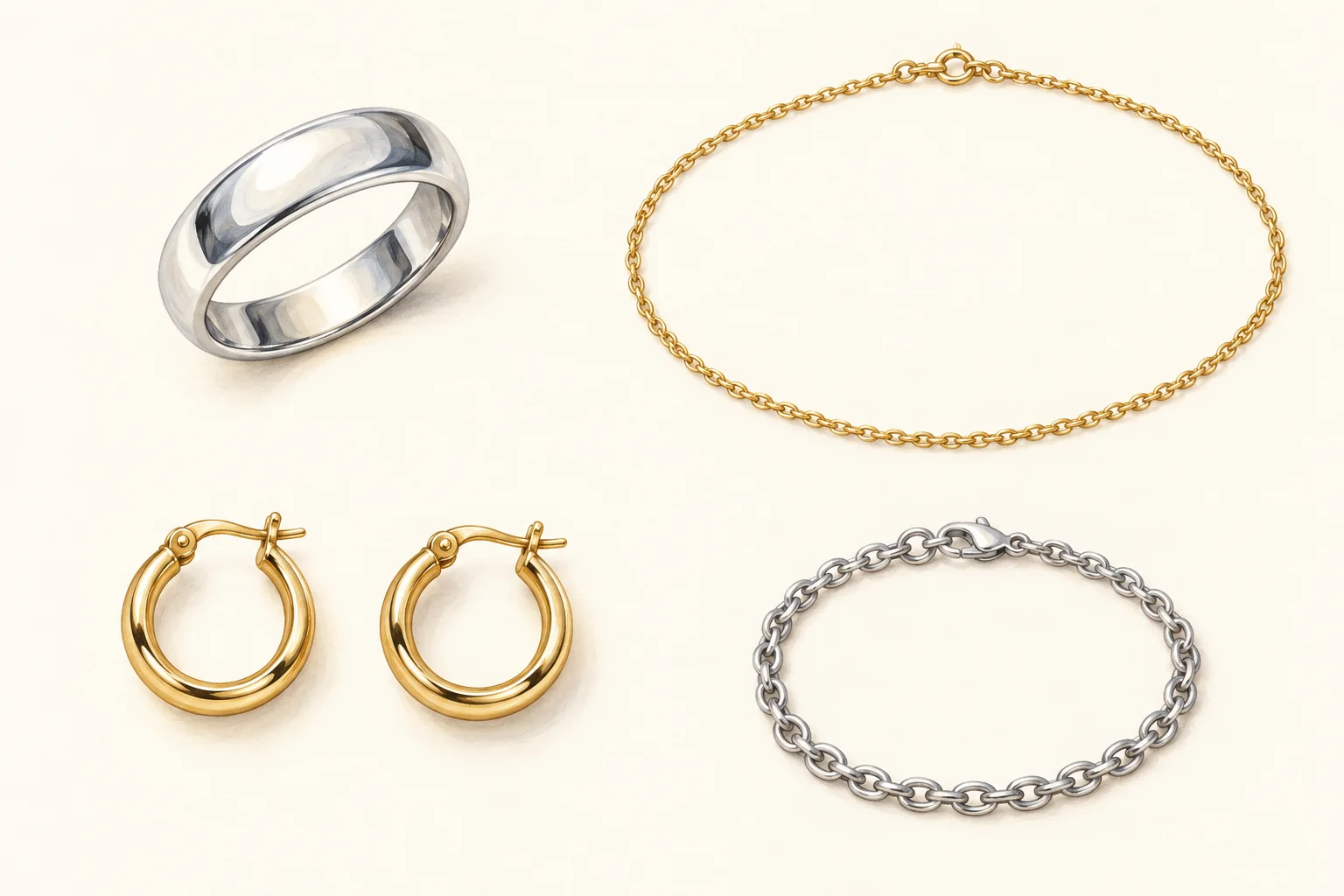
Names, articles and plurals
Read the first two columns aloud together. The plural article is die, even when the singular has der or das. The example or meaning column helps you keep the intended sense.
| German | Plural | English meaning |
|---|---|---|
| der Ring | die Ringe | ring |
| der Ehering | die Eheringe | wedding ring |
| die Halskette | die Halsketten | necklace |
| die Kette | die Ketten | chain; also necklace in context |
| der Ohrring | die Ohrringe | earring |
| das Armband | die Armbänder | bracelet |
| der Armreif | die Armreife | bangle |
| die Brosche | die Broschen | brooch |
| der Anhänger | die Anhänger | pendant in jewellery context |
| die Perle | die Perlen | pearl / bead, depending on material |
Replay a line, transcript and audio files
der Ring. die Ringe.
Open audio file 1der Ehering. die Eheringe.
Open audio file 2die Halskette. die Halsketten.
Open audio file 3die Kette. die Ketten.
Open audio file 4der Ohrring. die Ohrringe.
Open audio file 5das Armband. die Armbänder.
Open audio file 6der Armreif. die Armreife.
Open audio file 7die Brosche. die Broschen.
Open audio file 8der Anhänger. die Anhänger.
Open audio file 9die Perle. die Perlen.
Open audio file 10
Separate the item from the material
Der Schmuck names jewellery as a collection. For two items, say zwei Schmuckstücke or name the pieces: ein Ring und ein Armband. Do not use a made-up everyday plural to count a collection.
Aus identifies a material: Der Ring ist aus Silber. In ein silberner Ring, the adjective has an ending. You can ask Ist das echtes Silber? without making a claim about the object. Kette and Anhänger have other meanings outside a jewellery context, so retain the sentence around them.
An original short exchange
Read both roles. Then cover one speaker and supply a suitable reply. The wording below is a model, not the only possible exchange.
- Kundin
- Ich suche ein Armband als Geschenk.
- Verkäufer
- Soll es aus Silber sein?
- Kundin
- Ja. Kann man die Länge ändern?
- Verkäufer
- Bei diesem Modell geht das.
- Kundin
- Darf ich es mir genauer ansehen?
Ask about the piece you mean
Change Armband to Halskette. Replace es with sie because die Halskette is feminine: Darf ich sie mir genauer ansehen? Then change the item to Ring and use ihn.
For a lost item, give a concrete description: Ich habe einen kleinen Ohrring verloren. Write the location and one distinguishing detail. A useful description is more precise than simply saying Mein Schmuck ist weg.
Put it into practice
Try each task before opening the answer. Open questions show one possible model answer.
Name one earring, with its article.
Answer and explanation
der Ohrring
The two r letters are part of the spelling.
Give the plural of das Armband.
Answer and explanation
die Armbänder
The plural has an umlaut and -er.
Complete: Der Ring ist __ Gold.
Answer and explanation
aus
Aus introduces the material.
Count two individual pieces using Schmuckstück.
Answer and explanation
zwei Schmuckstücke
Schmuckstück is countable.
Replace die Halskette with an object pronoun: Darf ich __ ansehen?
Answer and explanation
sie
The accusative feminine pronoun is sie.
Say that you have lost one earring.
Answer and explanation
Ich habe einen Ohrring verloren.
The masculine accusative is einen Ohrring.
Questions learners ask
Are Kette and Halskette the same?
Halskette explicitly means a necklace. Kette can refer to a necklace in a jewellery context, but also to other kinds of chain.
How do I ask about material?
Use Woraus ist der Ring? or Ist der Ring aus Silber? The first question is open; the second asks about a specific material.