
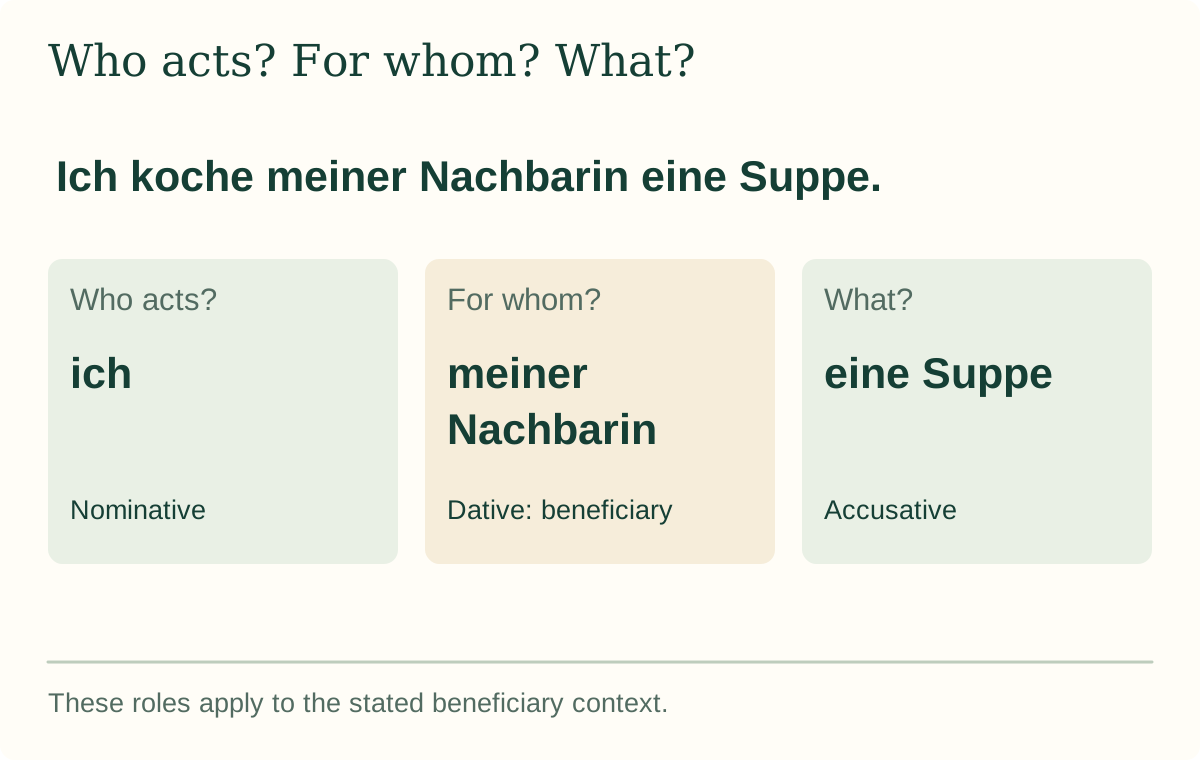
Dativus commodi: who benefits from the action?
In a dativus commodi construction, someone benefits from an action. In the following context, the speaker cooks soup for her neighbour, who is meant to eat it later. A paraphrase with für helps make that role visible.
This paraphrase explains the example. It does not tell you to replace every dative with für. A verb such as helfen belongs to a different sentence pattern.
Ich koche meiner Nachbarin eine Suppe.
Meiner Nachbarin is dative; eine Suppe is the accusative object. In the stated context, the neighbour is the beneficiary.
Ich koche eine Suppe für meine Nachbarin.
Here the prepositional phrase expresses a similar beneficiary relationship. Für takes accusative, so this is not a dative phrase.
Possession: whose hands or jacket?
A possessive or pertinence dative can connect a person with a body part, item of clothing or closely associated object. The relationship must be understandable from the construction and context.
Mir is therefore not simply another word for the hands. It refers to a person. Ask separately which expression names the body part and which names the associated person.
Ich wasche mir die Hände.
Mir refers to the person whose hands are being washed. The phrase die Hände remains the accusative phrase.
Dem Kind zittern die Hände.
Die Hände is the subject; dem Kind names the person to whom the hands belong.
Distinguish emotional involvement from judgement
An ethical dative can express personal involvement or emphasis. When someone worriedly says Bleib mir bloß gesund!, mir does not, in the intended reading, identify a person receiving an object.
In a judgement, the dative can instead indicate whose perspective applies. Die Musik ist mir zu laut states the speaker’s standard of judgement. This use is also called dativus iudicantis.
| Use | Original example | What the dative contributes |
|---|---|---|
| Benefit | Ich koche meiner Nachbarin eine Suppe. | The neighbour is intended to benefit. |
| Possession | Ich wasche mir die Hände. | The hands belong to the named person. |
| Emotional involvement | Bleib mir bloß gesund! | The speaker expresses concern here. |
| Judgement | Die Musik ist mir zu laut. | The judgement applies from the speaker’s perspective. |
Why omission alone is not a reliable test
You cannot decide whether a dative phrase is selected by the verb merely by checking whether the sentence is possible without it. Even a selected complement can remain unspoken in a suitable context.
Compare Sie hilft ihrem Bruder with Kannst du heute helfen? The absence of a dative object in the second sentence does not automatically make ihrem Bruder in the first sentence a free dative. Check the verb’s pattern and intended meaning together.
Grammatical frameworks also draw the boundary differently. The IDS description explicitly notes that possessive and beneficiary datives can be analysed as optional complements. The meaning role can be clear even when theoretical labels differ.
A sentence can allow several interpretations without context
Imagine Zieh mir die Jacke an! in two situations. Someone asks for help putting on their own jacket. Alternatively, a worried parent tells a child to put on the child’s jacket, using mir to add emphatic personal involvement.
The wording alone does not make every interpretation unambiguous. Ask about the context before insisting on one label. A learning exercise must state the relevant roles explicitly.
Explain a dative phrase step by step
First find the verb and check its basic pattern. Then identify the person named by the dative and the connection between that person and the action or object. Only then choose the appropriate meaning label.
For example, a useful explanation is: the neighbour is expressed in the dative because she is the beneficiary in this context. Simply saying that something is dative does not explain why it is used in that situation.
Check your understanding
Try each task before opening the model answer. Open tasks can have other valid answers.
The soup is intended for the neighbour: Ich koche meiner Nachbarin eine Suppe. Who benefits?
Answer and explanation
The neighbour.
Meiner Nachbarin is the dative phrase naming the person intended to benefit from the action.
Identify the accusative phrase in Ich koche meiner Nachbarin eine Suppe.
Answer and explanation
eine Suppe
This is the food being cooked. The beneficiary is named separately with meiner Nachbarin.
In „Ich wasche mir die Hände“, the speaker’s own hands are meant. What relationship does mir express?
Answer and explanation
The hands belong to the speaker.
Mir names the person; die Hände names the body part. The usual construction here uses die Hände.
Which phrase is the subject in Dem Kind zittern die Hände?
Answer and explanation
die Hände
Dem Kind is dative and names the associated person. The plural subject die Hände agrees with zittern.
Someone expresses concern for a person close to them: Bleib mir bloß gesund! What role does mir have in this reading?
Answer and explanation
Emotional speaker involvement: an ethical dative.
The context describes personal concern rather than receiving an object.
Die Musik ist mir zu laut. From whose perspective is it too loud?
Answer and explanation
From the speaker’s perspective.
Here the dative phrase identifies the viewpoint of the judgement.
Does Kannst du heute helfen?, without a dative phrase, prove that a dative after helfen must always be free?
Answer and explanation
No. A selected complement can remain unspoken in a suitable context.
Omission alone does not reliably settle the valency question.
In the soup example, express the beneficiary using für instead of a dative phrase.
Answer and explanation
Ich koche eine Suppe für meine Nachbarin.
Für takes accusative. In this context, the paraphrase preserves the beneficiary role, but it is not a universal replacement rule for datives.
Frequently asked questions
Is every German dative a dative object?
No. A dative phrase can, for example, identify a beneficiary or involved person. The construction and its analysis as a complement or free addition need to be examined separately.
Are dativus commodi and free dative the same thing?
Dativus commodi names the beneficiary relationship. Free dative is a broader category covering several uses. Some grammatical frameworks analyse certain beneficiary datives as optional complements.
Can every dative be paraphrased with für?
No. The paraphrase can help in a suitable beneficiary context. It is not a rule for possessive datives, emotional uses or ordinary verb-selected dative patterns.