
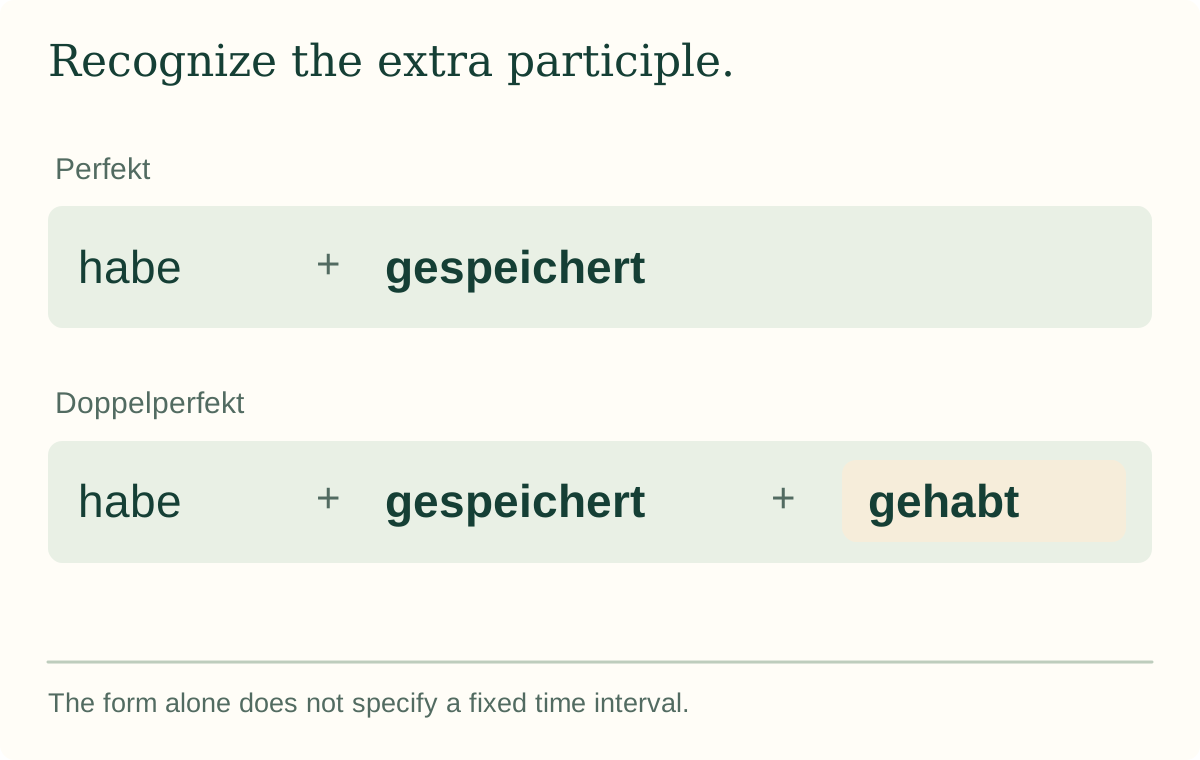
Recognize the extra gehabt or gewesen
First examine the whole verb complex. In Ich habe die Datei gespeichert gehabt, habe is finite and gespeichert and gehabt are participles. The additional auxiliary participle distinguishes the construction from ordinary Ich habe die Datei gespeichert.
Ich habe die Datei gespeichert.
An ordinary perfect with habe and gespeichert.
Ich habe die Datei gespeichert gehabt.
A double perfect: gehabt is added to the verb complex.
Sie ist vor dem Regen abgereist gewesen.
Here the additional auxiliary participle is gewesen.
Compare four forms
Using the same main verb, you can compare the visible structures. The table initially shows their formation. It does not claim that all four mean the same thing or are equally common in every situation.
Patterns with sein similarly distinguish ist … gewesen and war … gewesen. Choose the auxiliary appropriate to the main verb; do not attach gehabt indiscriminately to every perfect form.
| Name | Example | Auxiliary form and participles |
|---|---|---|
| Perfekt | Ich habe die Datei gespeichert. | habe + gespeichert |
| Plusquamperfekt | Ich hatte die Datei gespeichert. | hatte + gespeichert |
| Doppelperfekt | Ich habe die Datei gespeichert gehabt. | habe + gespeichert + gehabt |
| Doppelplusquamperfekt | Ich hatte die Datei gespeichert gehabt. | hatte + gespeichert + gehabt |
What does the form mean in its context?
Double-perfect forms can, among other things, highlight an earlier situation as already completed. The double perfect also occurs in contexts where an ordinary pluperfect version is possible. A mechanical one-to-one translation does not explain every occurrence, however.
Check the time expressions and surrounding statement first. The additional form alone specifies neither an exact date nor a fixed interval between events.
Ich habe die Datei schon gespeichert gehabt, bevor der Akku leer wurde.
In this context, saving the file is presented as completed before the battery ran out.
Ich hatte die Datei schon gespeichert, bevor der Akku leer wurde.
Here an ordinary neutral version can express the earlier action using the pluperfect.
Take usage and register seriously
These forms occur particularly in speech and regionally influenced usage. They cannot simply be classified as never written or always wrong. IDS descriptions also provide written examples and discuss possible nuances of meaning.
For a factual message of your own, choose an ordinary past form if it clearly expresses the context. When understanding a conversation, however, recognize the construction before dismissing the extra participle as a meaningless error.
Not every gehabt or complex perfect is a double perfect
In Ich habe Glück gehabt, gehabt is the participle of the main verb haben. There is no additional main-verb participle such as gespeichert. This sentence uses the ordinary perfect.
Ich habe die Treppe putzen müssen is not a double perfect either. Its modal verb appears as a substitute infinitive, or Ersatzinfinitiv. This is a different formation pattern; counting the number of verb words is not enough to classify it.
Ich habe Glück gehabt.
The ordinary perfect of the main verb haben.
Ich habe die Treppe putzen müssen.
A perfect with a modal verb and substitute infinitive, not a main-verb participle plus extra gehabt.
Interpret a form you hear sensibly
Mark the finite verb and other verb parts. Then check whether an auxiliary participle occurs in addition to a main-verb participle. Only then connect the construction with the time relationships in context.
When rephrasing, preserve the intended sequence and focus of information first. A smoother-sounding form is not automatically an accurate rendering of the content. With unclear context, a cautious explanation is better than inventing a fixed time meaning.
Check your understanding
Try each task before opening the model answer. Open tasks can have other valid answers.
Identify the form: Ich habe die Datei gespeichert gehabt.
Answer and explanation
Doppelperfekt: double perfect.
Gehabt appears in addition to gespeichert; habe is the finite auxiliary.
Identify the form: Ich hatte die Datei gespeichert.
Answer and explanation
Plusquamperfekt: pluperfect.
Hatte is a past-tense form, and there is no additional gehabt.
Identify the form: Ich hatte die Datei gespeichert gehabt.
Answer and explanation
Doppelplusquamperfekt: double pluperfect.
Hatte combines with gespeichert and additional gehabt.
Is „Ich habe Glück gehabt“ a double perfect?
Answer and explanation
No. It is the ordinary perfect of the main verb haben.
Gehabt is the main-verb participle here; it is not added after another main-verb participle.
Is „Ich habe die Treppe putzen müssen“ a double perfect?
Answer and explanation
No. It is a perfect pattern with a modal verb and substitute infinitive.
Putzen and müssen are infinitives. Distinguish this pattern from adding an auxiliary participle.
Which additional participle appears in „Sie ist vor dem Regen abgereist gewesen“?
Answer and explanation
gewesen
It supplements the pattern with sein and the main-verb participle abgereist.
For a neutral message, rephrase using the ordinary pluperfect: Ich habe die Datei schon gespeichert gehabt, bevor der Akku leer wurde.
Answer and explanation
Ich hatte die Datei schon gespeichert, bevor der Akku leer wurde.
In this explicitly stated context, saving remains completed before the battery runs out. This is not a universal substitution rule for every occurrence.
Which claim is too sweeping: “These forms occur in usage” or “Double-perfect forms are always wrong and never appear in writing”?
Answer and explanation
The claim “always wrong and never written” is too sweeping.
Actual usage and written examples require an assessment that considers context and register.
Frequently asked questions
Is gemacht gehabt always just an error?
No. Double-perfect forms are documented in usage and described grammatically. Their frequency, function and effect need to be assessed by context and register.
Must I use the double perfect myself?
No. You can often choose an ordinary perfect or pluperfect for clear messages. Recognizing the double pattern is useful for comprehension.
Does every sentence-final gehabt indicate a double perfect?
No. In Ich habe Glück gehabt, gehabt is the main-verb participle of haben and belongs to an ordinary perfect. The whole verb complex matters.