
For DTZ speaking Part 2, describe the main situation in your picture, then answer questions about the topic and your own experience. Separate what you can see from what you think might be happening: Ich sehe … reports an observation; Vielleicht … marks a guess. You are practising communication, not identifying a hidden story.
The official task is called Über Erfahrungen sprechen. The current g.a.s.t. practice set includes a picture prompt and follow-up questions. This guide uses an original practice scene and examples; it does not reproduce an official test. Source: g.a.s.t., Übungssatz 1, pp. 34–35.
1. What actually happens in DTZ speaking Part 2?
In the usual pair test, each learner receives a different picture on a shared topic. Learners speak in turn, then respond to the examiner’s questions. The official practice set allocates approximately six minutes to Part 2 for both learners together. This is not a six-minute speech for each person. Source: g.a.s.t., p. 28.
| Speaking part | Main action | Approximate pair-test time |
|---|---|---|
| 1 | Introduce yourself; answer follow-up questions | 4 minutes |
| 2 | Speak from a picture; discuss experiences | 6 minutes |
| 3 | Plan something together | 6 minutes |
The conversation lasts about 16 minutes, with no preparation time. The practice set’s approximately 20-minute allocation also includes four minutes for the examiners’ discussion. g.a.s.t. overview; practice-set timing.
2. How do I start describing the picture?
Try this practice sequence: main situation → people and actions → one useful detail → cautious interpretation. It is an editorial aid, not an official required order.
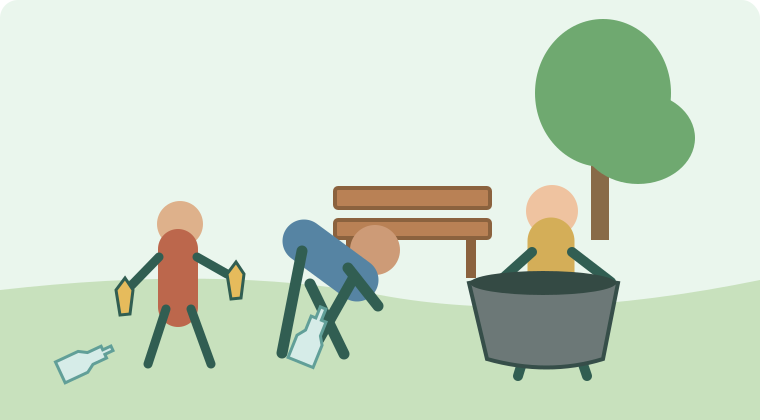
A possible opening:
Auf dem Bild sehe ich drei Personen draußen. Eine Person hebt eine Flasche auf. Eine andere Person hält einen Müllsack. Links steht ein Kind mit Handschuhen. Im Hintergrund sehe ich eine Bank und einen Baum. Vielleicht sammeln die Personen gemeinsam Müll.
That is enough to establish the scene. You can add details, but avoid spending your whole answer listing colours and clothing.
3. Can I guess who the people are or what they feel?
Yes, as an interpretation. Use a phrase that shows uncertainty. The drawing supports Ein Kind steht neben zwei Erwachsenen. It does not establish Das sind die Eltern des Kindes. A careful alternative is Vielleicht ist das eine Familie.
| Purpose | Useful German | Meaning |
|---|---|---|
| Observation | Ich sehe … / Eine Person hält … | I see … / A person is holding … |
| Position | Links steht … / Im Hintergrund ist … | On the left … / In the background … |
| Interpretation | Vielleicht … / Ich vermute, dass … | Perhaps … / I suspect that … |
| Uncertainty | Das kann ich nicht genau erkennen. | I cannot make that out exactly. |
| Missing word | Ich kenne das Wort nicht. Man benutzt es, um … | I do not know the word. You use it to … |
For example: Ich vermute, dass sie den Park sauber machen. Notice the final verb after dass. With vielleicht, use a main clause: Vielleicht machen sie den Park sauber.
4. How do I connect the picture to my own experience?
Listen to the actual question. A question about your experience needs a personal answer, not another description of the picture. Use a simple pattern: answer → example → reason or result.
Original practice dialogue:
Practice partner: Haben Sie schon einmal bei einer Aufräumaktion mitgemacht?
Learner: Ja, letztes Jahr habe ich mit meinen Nachbarn Müll gesammelt. Wir waren im Park. Danach war der Platz sauberer. Ich fand die Aktion gut, weil wir zusammen etwas für unsere Umgebung gemacht haben.
If you have no direct experience, say so: Ich habe das noch nicht selbst gemacht. In meiner Nachbarschaft gibt es aber manchmal solche Aktionen. Give a related observation if you have one. Do not memorise an invented biography. Practise follow-ups such as who joined, what happened and what you thought.
5. What should I practise beyond a memorised description?
Practise identifying the main content, adding relevant details and responding to new questions. The official B1 task descriptors include naming a photo’s main contents and details and reporting personal experiences with some detail. Source: g.a.s.t., p. 45. A reusable phrase helps you begin; a fixed speech about another picture cannot answer the picture in front of you.
Use these three original exercises:
- Observation or guess? Classify: A) Eine Person hält einen Müllsack. B) Das Kind ist acht Jahre alt. C) Vielleicht kennen sich die Personen.
Show the answer
Answers: A is visible. B is an unsupported precise claim. C is a clearly marked interpretation.
- Make the claim careful. Change Die Erwachsenen sind die Eltern.
Show the answer
Possible answer: Vielleicht sind die Erwachsenen die Eltern des Kindes.
- Answer a follow-up. Explain whether you would join a cleanup and why.
Show the answer
Possible answer: Ja, ich würde mitmachen, weil ich einen sauberen Park wichtig finde. Am Samstag hätte ich Zeit. Your own relevant answer can differ.
For your next session, describe a fresh scene aloud, then ask someone to change the follow-up questions. For additional practice, explore Lingeva’s independent exam preparation and AI Speaking for German conversations. All AI Speaking and Exam Prep A1–C1 require Premium, subject to an applicable existing trial entitlement. Account access and usage limits apply. Use these alongside the official DTZ practice sets. See Lingeva Premium and subscribe in the app.
Sources
- Der DTZ auf einen Blick – Informationen für Teilnehmende und Prüfungsanbieter — g.a.s.t.. Checked 8 October 2026.
- Deutsch-Test für Zuwanderer A2–B1: Übungssatz 1 — g.a.s.t.. Checked 8 October 2026.