
Vehicle names, articles and plurals
The article belongs to the noun’s grammatical gender. Learn der Zug and die Züge together so you can recognise the singular and plural in a timetable conversation. These examples are Standard German; transport systems and local service names vary.
| Singular | Plural | Meaning | Original sentence |
|---|---|---|---|
| der Bus | die Busse | bus | Ich fahre mit dem Bus. |
| die Straßenbahn | die Straßenbahnen | tram | Die Straßenbahn hält hier. |
| die U-Bahn | die U-Bahnen | underground train | Ich nehme die U-Bahn. |
| die S-Bahn | die S-Bahnen | urban/suburban rail | Wir steigen in die S-Bahn ein. |
| der Zug | die Züge | train | Der Zug fährt um neun ab. |
| das Fahrrad | die Fahrräder | bicycle | Ich fahre mit dem Fahrrad. |
| das Auto | die Autos | car | Das Auto steht vor dem Haus. |
| das Taxi | die Taxis | taxi | Wir nehmen ein Taxi. |
| das Motorrad | die Motorräder | motorcycle | Sie fährt Motorrad. |
| der Roller | die Roller | scooter | Der Roller steht neben dem Fahrrad. |
| das Schiff | die Schiffe | ship | Das Schiff legt am Hafen an. |
| das Flugzeug | die Flugzeuge | aircraft | Wir reisen mit dem Flugzeug. |
Say how you travel
Mit takes the dative. The examples Ich fahre mit dem Bus and Ich fahre mit dem Fahrrad show dem with these masculine and neuter nouns. With the feminine Straßenbahn, say mit der Straßenbahn. When you use nehmen, the sentence is built differently: Ich nehme den Bus.
Ich fahre mit der Straßenbahn zum Kurs.
Name the means of transport with mit.
Ich nehme den Bus zum Bahnhof.
Name the vehicle directly after nehmen.
Heute gehe ich zu Fuß.
On foot is a useful route option, although it is not a vehicle.
Choose a vehicle for an original route task
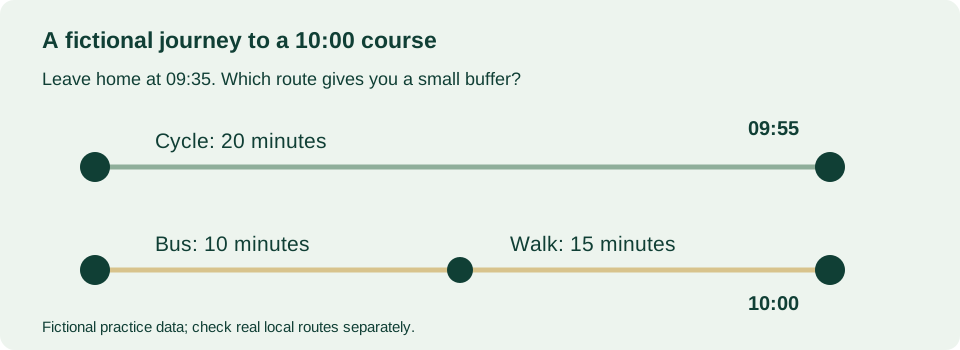
Practice situation: your course starts at 10:00. You can cycle from home to the course in 20 minutes, or take a bus for 10 minutes and walk another 15 minutes. These are fictional task times. If you leave at 9:35, cycling reaches the course at 9:55; the bus-and-walk option reaches it at 10:00 with no extra buffer.
Choose a route and explain the choice in one sentence. The task is about using the words and times together, not proving which vehicle is always best. Real routes require a current timetable and local conditions.
Retrieve the word before reading the list
Cover the table. Name three vehicles with articles, give one plural and describe your usual journey. Then change one fact: rain, a missed bus or a different meeting time. Use the existing directions guide when you need to describe the street route rather than the vehicle itself.
- My three vehicles with articles: ______
- One singular/plural pair: ______
- My usual journey: ______
- One changed condition and a new sentence: ______
Six tasks to practise
Try each task before opening the answer. Open tasks show one model; equivalent appropriate answers are also possible.
Give the plural of der Zug.
Answer and explanation
die Züge
The plural has an umlaut and ends in -e.
Complete: “Ich fahre mit ___ Straßenbahn.”
Answer and explanation
der
Mit takes dative; Straßenbahn is feminine.
Complete: “Ich nehme ___ Bus.”
Answer and explanation
den
Bus is masculine and is the direct object in this sentence.
In the route task, when do you arrive if you cycle from 9:35 for 20 minutes?
Answer and explanation
At 9:55.
Add 20 minutes to the departure time.
How do you say on foot?
Answer and explanation
zu Fuß
This phrase describes walking, not a vehicle.
Describe a journey using two transport stages.
Answer and explanation
Ich fahre mit dem Bus zum Bahnhof und nehme dann den Zug.
The model combines a mit phrase with nehmen. Other plausible journeys are possible.
Questions learners ask
Should I learn German vehicle words with articles?
Yes: the article and plural help you build phrases such as mit dem Bus and recognise more than one vehicle.
Are S-Bahn and U-Bahn the same thing?
They are different service labels. Learn the local network’s actual routes; the vocabulary list alone does not tell you which system serves a particular destination.