
Ask for the destination and the help you need
Name the place you want to reach rather than listing several uncertain landmarks. A question can request a route, a location or a repeat. These phrases are reusable starting points; the actual reply determines your next step.
| Job | German phrase | Meaning |
|---|---|---|
| Ask for brief help | Entschuldigung, können Sie mir kurz helfen? | A possible polite opening, not a compulsory formula. |
| Ask for a route | Wie komme ich zum Bahnhof? | How do I get to the station? |
| Name a different destination | Wie komme ich zur Bibliothek? | How do I get to the library? |
| Continue in the same direction | Gehen Sie geradeaus weiter. | Continue straight ahead. |
| Make a turn at a named point | Biegen Sie an der Kreuzung links ab. | Turn left at the intersection. |
| Name the endpoint of a step | Gehen Sie bis zur zweiten Kreuzung. | Go as far as the second intersection. |
| Check one part of the instruction | Meinen Sie die erste oder die zweite Kreuzung? | Do you mean the first or the second intersection? |
| Ask for a visual explanation | Können Sie mir den Weg auf der Karte zeigen? | Can you show me the route on the map? |
Use one map and one stated starting view
Use the same map for both worked routes and the exercises. Start at S and face north, toward the top of the picture. A is the first intersection in front of you; D is the second if you keep going straight. The diagram is fictional and has no distance scale. Do not infer walking times from its spacing.
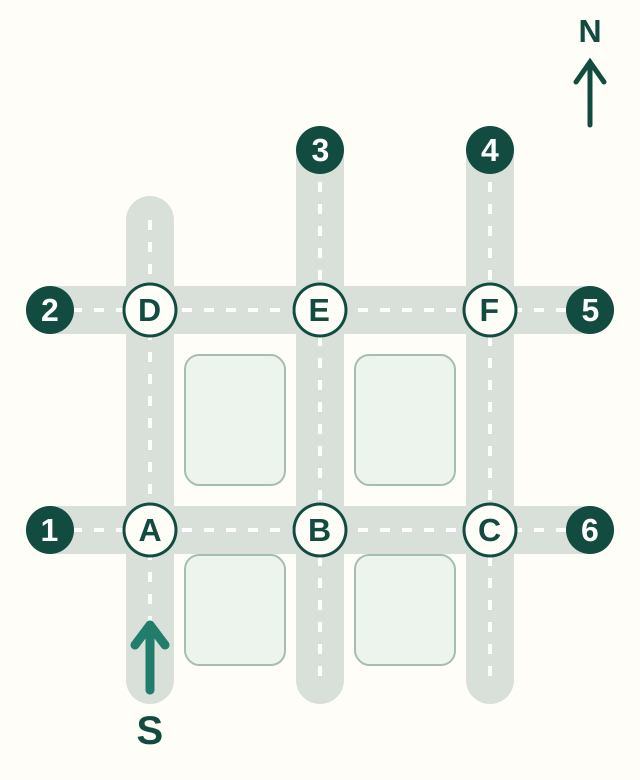
| Number | German noun | Plural | Position on this map |
|---|---|---|---|
| 1 | die Bäckerei — bakery | die Bäckereien | west of A |
| 2 | die Bibliothek — library | die Bibliotheken | west of D |
| 3 | der Bahnhof — station | die Bahnhöfe | north of E |
| 4 | der Park — park | die Parks | north of F |
| 5 | die Apotheke — pharmacy | die Apotheken | east of F |
| 6 | das Café — café | die Cafés | east of C |
| Row | West | Middle | East |
|---|---|---|---|
| Upper row | D | E | F |
| Lower row | A | B | C |
Horizontal streets join D–E–F and A–B–C. Vertical streets join D–A, E–B and F–C. S connects to A from below. The numbered destinations lie at the ends shown in the key; they are not additional intersections. These relationships also supply a text version of the map.
Follow two complete worked routes
| Destination | Complete German route | Check the route |
|---|---|---|
| der Bahnhof (3) | Gehen Sie von S geradeaus bis zur Kreuzung A. Biegen Sie rechts ab und gehen Sie bis B. Biegen Sie dort links ab. Überqueren Sie die Kreuzung E und gehen Sie geradeaus weiter bis zum Bahnhof (3). | S → A → B → E →3. At A, north becomes east: turn right. At B, east becomes north: turn left. |
| die Bibliothek (2) | Geh von S geradeaus über die Kreuzung A bis zur Kreuzung D. Bieg dort links ab. Am Ende dieses Weges ist die Bibliothek (2). | S → A → D →2. Pass the first intersection and turn left at the second. The two routes use different destinations and turns. |
Check the walker’s view after each turn
Left and right belong to the person following the instruction. They are not permanent labels for the left and right edges of a page. After every turn, imagine where that person is now looking. From S you face north. From the station back toward E you face south, so your left points east, toward F.
Give one action and its reference point, then the next step: An der Kreuzung A biegen Sie rechts ab. Danach gehen Sie bis B. Words such as zuerst, dann and danach help the listener keep the order. A numbered or named landmark is clearer than several unanchored instructions to turn.
Keep the address form and whole instruction together
Use one address form consistently. With formal Sie, say Gehen Sie bis zur Kreuzung. To one person you address as du, say Geh bis zur Kreuzung. Choose the form that fits your relationship and the situation. A polite opening such as Entschuldigung can help when approaching a stranger; it is an option rather than a required part of every directions question.
In Biegen Sie links ab., ab is the separated part of abbiegen. Keep the whole instruction when learning it. In zum Bahnhof and zur Bibliothek, zum means zu dem and zur means zu der. These destination phrases use dative after zu; movement does not automatically mean accusative. Detailed destination choice belongs to the existing zu/nach comparison.
Clarify the step you did not understand
If one step is unclear, ask about that step rather than agreeing and guessing. You can repeat the uncertain point: Also an B links? Or ask for the instruction again: Können Sie den letzten Schritt bitte wiederholen? This gives the other person something specific to confirm or correct.
If you do not know a route yourself, Das weiß ich leider nicht. is a useful honest reply. You can ask someone to show the destination on a map without pretending that the route, distance or opening time is known. The maps and dialogues here are language practice, not live travel information.
Eight route and reply checks
Choose or say your answer before opening its explanation. For open responses, the key gives one possible model; other clear, grammatical answers can work.
You start at S facing north. To reach the bakery (1) by the direct route through A, do you turn left or right at A?
Show answer and explanation
Links. Turn left: north becomes west. The bakery is west of A. Turning right leads toward B.
Trace this route: S → A, right to B, left to E, then straight to the numbered endpoint. Which destination do you reach?
Show answer and explanation
Der Bahnhof (3). From B the left turn points north. You pass E and reach 3. The park is on the different vertical street through F.
Start at the station (3) and face south toward E. At E, turn left. Which intersection comes next: D or F?
Show answer and explanation
F. With your view now facing south, left is east on this map. D would be the right turn.
A friend wants the library (2) from S. Does An der ersten Kreuzung links. or An der zweiten Kreuzung links. fit the direct route?
Show answer and explanation
An der zweiten Kreuzung links. The first is A; the second is D. Turning left at A reaches the bakery instead.
From S, what comes first on the worked station route: turning right at A or turning left at B?
Show answer and explanation
Turn right at A first. You must reach B along the lower horizontal street before you can turn north there.
Complete the formal turning instruction with the separated verb part: Biegen Sie an B links ___.
Show answer and explanation
ab. The complete instruction is Biegen Sie an B links ab. It belongs to the separable verb abbiegen.
You are unsure whether the speaker said the first or second intersection. Ask for that specific distinction.
Show answer and explanation
Meinen Sie die erste oder die zweite Kreuzung? This is one model. A clear question repeating the two alternatives is also acceptable.
Choose the route question, not the train-departure question: Wie komme ich zum Bahnhof? / Wann fährt der Zug ab?
Show answer and explanation
Wie komme ich zum Bahnhof? asks how to reach the station. The other question asks when the train leaves.
Practise a changed route, then check the language
Choose a different destination on the same map. Say the start, facing direction and each turning point, then ask a partner to trace it. If they reach a different place, compare the first point where your routes separate. For the grammar behind a phrase, use the existing imperative guide and wo/wohin/woher comparison.
Questions about this topic
How do I ask for directions in German?
A useful model is Entschuldigung, wie komme ich zum Bahnhof? Replace the destination with the place you need. The opening is a polite option, not a required word in every conversation.
Does left always mean the left edge of the map?
No. It refers to the person following the instruction. Establish their facing direction and update it after every turn.
Should I use zum or zur in a destination phrase?
Zum is zu dem; zur is zu der. Compare zum Bahnhof and zur Bibliothek. Zu governs dative; the existence of movement does not change that.
Sources and further learning
- Deutsche Welle: Deutschtrainer24 — Den Weg beschreiben
- Goethe-Institut: Köln — Redemittel zur Wegbeschreibung, Seite 3
- IDS grammis: zu — Dativ und Verschmelzung mit dem Artikel
- Duden: links und rechts — Schreibung und Gebrauch
Source links checked: .
Use this in your German practice
Try the examples and answer checks on this page. For a wider routine, explore Lingeva’s grammar, vocabulary and speaking practice. Available app features and plan allowances are explained on the plan page.