
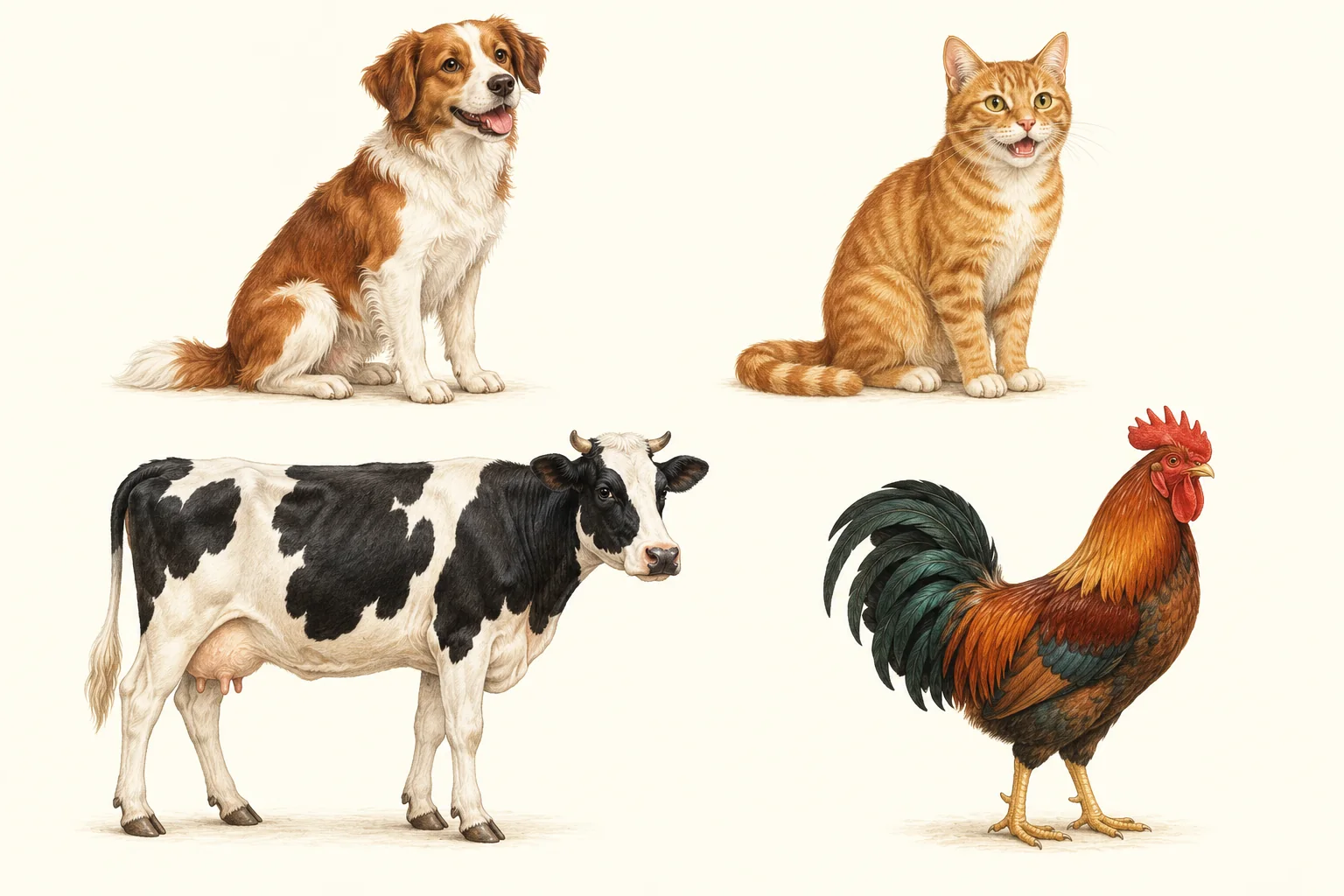
Animal, written sound and verb
Written imitations vary with the author and context. The entries are recognisable examples, not a rule that every German text must use exactly one spelling.
| Animal | Written imitation | Verb | Original sentence |
|---|---|---|---|
| der Hund | wau, wau | bellen | Der Hund bellt. |
| die Katze | miau | miauen | Die Katze miaut. |
| die Kuh | muh | muhen | Die Kuh muht. |
| das Schaf | mäh | blöken | Das Schaf blökt. |
| die Ente | quak | quaken | Die Ente quakt. |
| der Frosch | quak | quaken | Der Frosch quakt. |
| der Hahn | kikeriki | krähen | Der Hahn kräht. |
| die Gans | schnatter | schnattern | Die Gans schnattert. |
Replay a line, transcript and audio files
Der Hund bellt. wau, wau.
Open audio file 1Die Katze miaut. miau.
Open audio file 2Die Kuh muht. muh.
Open audio file 3Das Schaf blökt. mäh.
Open audio file 4Die Ente quakt. quak.
Open audio file 5Der Frosch quakt. quak.
Open audio file 6Der Hahn kräht. kikeriki.
Open audio file 7Die Gans schnattert. schnatter.
Open audio file 8
Use a verb when reporting what happened
Miau is a written imitation. Miauen is the infinitive of a verb; Die Katze miaut is a sentence. You can write Die Katze macht „miau“, but you do not need the quotation when using the verb.
The same written quak can be associated with an Ente or a Frosch. Context identifies the animal. Do not treat a sound word as an exact species identifier. With the verb, check agreement: Die Hunde bellen, but der Hund bellt.
Explain the sound in a picture
- A
- Was bedeutet „kikeriki“ unter dem Bild?
- B
- Das ist ein geschriebenes Tiergeräusch. Der Hahn kräht.
- A
- Und „miau“?
- B
- Das passt zur Katze. Die Katze miaut.
- A
- Dann schreibe ich einen ganzen Satz unter mein Bild.
Write a caption, then a sentence
Choose three animals. First write a short comic-style caption containing a sound word. Then replace it with a complete sentence using the verb. You are practising two text types, not replacing every animal verb with an imitation.
Read the short German model, cover the written sound and retrieve it. Then say the complete sentence. If you are listening to a real animal, use an actual recording from a clearly credited wildlife source rather than this spoken vocabulary model.
Put it into practice
Try each task before opening the answer. Open questions show one possible model answer.
Which written imitation commonly represents a cat?
Answer and explanation
miau
Miauen is the verb; miau is a written imitation.
Complete: Der Hund __. (bellen)
Answer and explanation
bellt
The singular subject takes bellt.
Complete: Die Hunde __. (bellen)
Answer and explanation
bellen
The plural subject takes bellen.
Give the verb for the sound of a rooster.
Answer and explanation
krähen
A complete sentence is Der Hahn kräht.
Does quak identify only a frog?
Answer and explanation
No. It can also be used for a duck.
The animal and context matter.
Turn the caption „muh“ into a sentence about a cow.
Answer and explanation
Die Kuh muht.
The sentence uses the inflected verb instead of only an imitation.
Questions learners ask
Are these real animal recordings?
No. They are spoken German models for the words and original sentences.
Is every sound word fixed?
No. Conventional spellings can vary. Learn the common forms with their verbs and recognise variation in comics and children’s texts.