
Learn a meaning contrast, not just two words
An adjective describes a property. An opposite pair contrasts a particular property: Das Glas ist voll. Das Glas ist leer. Here the property is how much liquid is in the glass. It is not the size, temperature or colour of the glass. Keeping the same question in mind helps you choose a useful contrast.
There is no reliable instruction to find one fixed opposite for every adjective. A word may have several meanings; some contrasts have middle points; some adjectives do not have a familiar single-word opposite. This guide starts with everyday pairs and shows the context needed to use them.
Three picture pairs: weight, contents and cleanliness
Read each picture pair with its captions. The captions state the intended fictional situation; an illustration alone cannot tell you an exact weight. Say the complete sentence once, then cover the adjective and retrieve it.
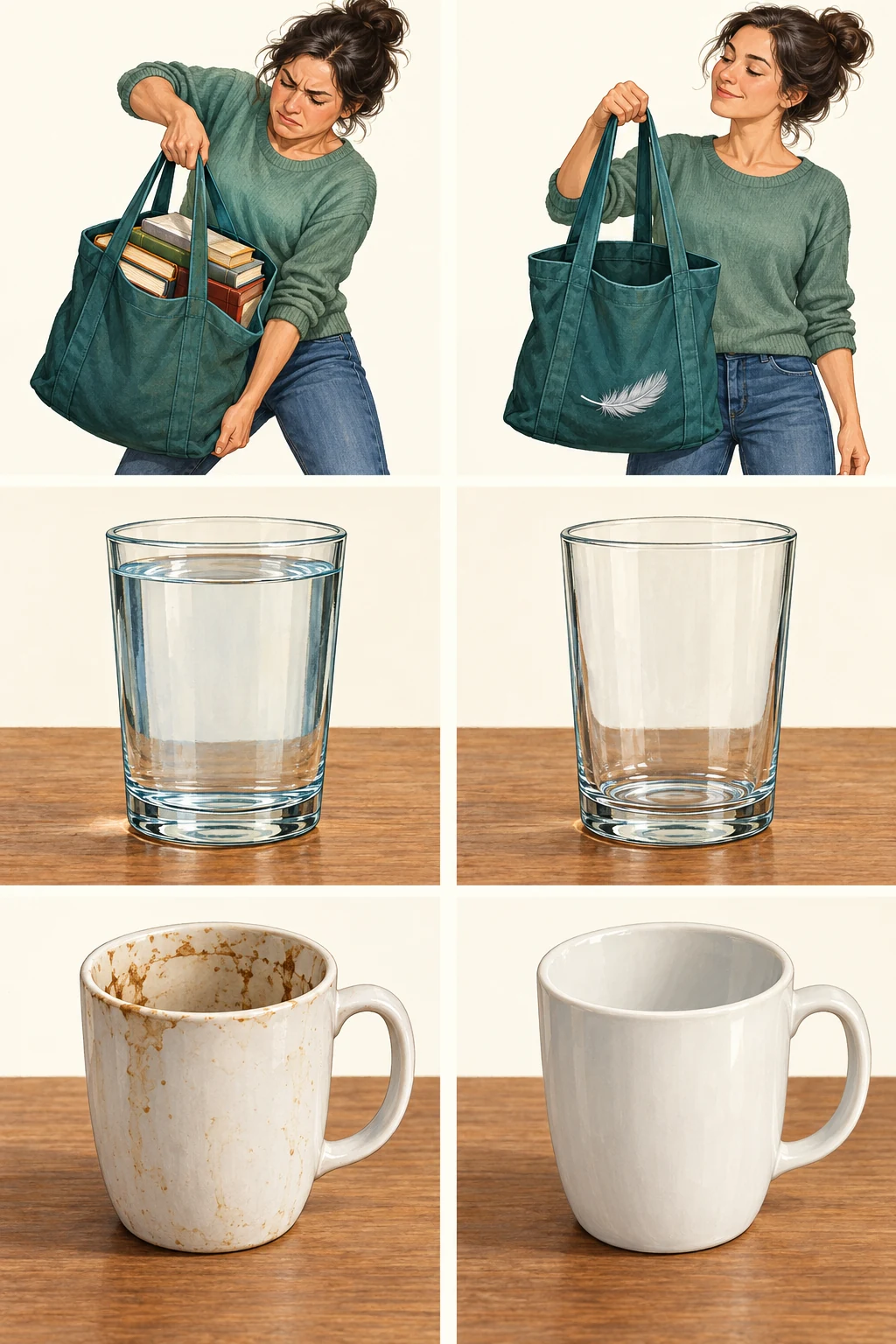
Common German adjective opposites with sentence examples
Use the meaning column to keep the pair tied to the intended question. The examples introduce different objects so you can also practise the noun and sein. They do not claim that every bus is slow or every jacket expensive.
| Pair | Meaning / context | Complete examples |
|---|---|---|
| schwer – leicht | heavy – light (weight) | Die Tasche ist schwer. Der Rucksack ist leicht. |
| schwer – leicht | difficult – easy (difficulty) | Die erste Aufgabe ist schwer. Die zweite Aufgabe ist leicht. |
| voll – leer | full – empty (contents) | Das Glas ist voll. Die Flasche ist leer. |
| schmutzig – sauber | dirty – clean (cleanliness) | Die Tasse ist schmutzig. Der Teller ist sauber. |
| groß – klein | big – small (size) | Der Tisch ist groß. Der Stuhl ist klein. |
| lang – kurz | long – short (length) | Der Text ist lang. Die Nachricht ist kurz. |
| warm – kalt | warm – cold (temperature) | Die Suppe ist warm. Das Wasser ist kalt. |
| heiß – kalt | hot – cold (temperature) | Der Tee ist heiß. Der Saft ist kalt. |
| laut – leise | loud – quiet (volume) | Die Musik ist laut. Das Radio ist leise. |
| hell – dunkel | bright/light – dark (brightness) | Das Zimmer ist hell. Der Flur ist dunkel. |
| schnell – langsam | fast – slow (speed) | Der Zug ist schnell. Der Bus ist langsam. |
| teuer – billig | expensive – cheap (price) | Die Jacke ist teuer. Das T-Shirt ist billig. |
| alt – neu | old – new (age/newness of objects) | Das Fahrrad ist alt. Der Helm ist neu. |
| alt – jung | old – young (age of living beings) | Der Hund ist alt. Die Katze ist jung. |
Billig often means low-priced; günstig can also suggest a favourable price or good value. Neither word needs to mean poor quality in every sentence. Temperature contrasts also depend on the comparison: warm is not identical to heiß. Start with the stated property instead of attaching one compulsory translation to each picture.
Does leicht mean “light” or “easy”?
Compare Der Koffer ist leicht. Ich kann ihn gut tragen. with Der Test ist leicht. Ich kann die Aufgaben gut lösen. The first sentence concerns weight; the second concerns difficulty. Their English translations use different words. German can use leicht in both situations.
The same applies to schwer: Der Koffer ist schwer. means heavy, while Der Test ist schwer. means difficult. If a drawing shows a large bag, size alone still does not establish its weight. You need the caption or situation. Ask yourself what the speaker is trying to describe.
Is the opposite of alt neu or jung?
For a living being’s age, a usual pair is alt – jung: Der Hund ist alt. Die Katze ist jung. For a long-used item compared with a newly bought unused item, use alt – neu: Mein Handy ist alt. Dein Handy ist neu. The question being asked decides the contrast.
These are useful contexts, not an absolute division between people and things. Die neue Kollegin can mean the colleague who has recently joined, without describing her age. Food can introduce another sense of alt, for which frisch may fit. Do not replace every occurrence of alt with jung or neu without reading the sentence.
Why “not full” does not always mean “empty”
A glass can be half full: Das Glas ist nicht voll, aber auch nicht leer. Someone can find a task neither very difficult nor very easy. Opposite words may describe two ends of a scale. Negation only rejects the particular statement; it does not always select the opposite endpoint.
Un- occurs in real pairs such as freundlich – unfreundlich. It is not a universal button for creating an opposite. Learn the actual expression; do not invent a word from the prefix when you mean billig, klein or leer. A dictionary and a complete example are more useful than a guessed formation.
Use the base form after sein and endings before nouns
In these descriptions after sein, the adjective does not change with the noun: Der Rucksack ist schwer. Die Tasche ist schwer. Das Paket ist schwer. Die Taschen sind schwer. The verb changes to sind for a plural subject; schwer keeps its form.
Before a noun, compare the nominative phrases ein schwerer Rucksack, eine schwere Tasche and ein schweres Paket. The ending belongs to the complete noun phrase. This small reference does not replace the adjective-endings guide; use that guide when the article or case changes.
Use a contrast to identify the right object
Two mugs are on the counter. One has been washed; the other still contains coffee stains. A: Welche Tasse meinst du? B: Ich meine die saubere Tasse. A: Die hier? B: Ja, genau. The answer gives the property that actually distinguishes the two mugs. You do not need to describe every possible property.
Try a second version with two bags: Ich nehme die leichte Tasche. Then change the situation so that both bags weigh the same but have different sizes. Now die kleine Tasche might identify the intended one. A useful adjective answers the listener’s uncertainty.
Ten checks with answers and reasons
Answer first, then open the explanation. A model sentence is not the only acceptable wording unless the task gives a specific form.
A bag weighs 15 kg and is hard to lift. Complete with the weight adjective from the reference: Die Tasche ist ___.
Check answer and explanation
Die Tasche ist schwer.
Schwer describes weight here. The context does not say that the bag is complicated or difficult to understand.
A grammar task is simple to solve. Complete with the opposite of schwer: Die Aufgabe ist ___.
Check answer and explanation
Die Aufgabe ist leicht.
The same German word leicht describes low difficulty here. Einfach is also a natural answer to the real situation, but this task specifically asks for the pair taught in the reference.
Choose the appropriate contrast for age, not whether an item was just bought: Der Hund ist alt. Der andere Hund ist ___.
Check answer and explanation
Der andere Hund ist jung.
Jung contrasts with alt when talking about the age of the dogs. Neu would usually introduce a different contrast, such as a new dog in a household.
One notebook is worn and has been used for years. The other has just been bought unused. Complete: Das alte Heft liegt links. Das ___ Heft liegt rechts.
Check answer and explanation
Das neue Heft liegt rechts.
Neu is the intended contrast of condition/newness. Neue has -e in the nominative phrase das neue Heft. Jung would not express the stated contrast.
Use sauber after ist: Die Tasse ist ___.
Check answer and explanation
Die Tasse ist sauber.
The adjective remains unchanged in this predicative pattern. Die Tasse ist saubere is not the required full sentence.
Complete this nominative phrase with schwer: Das ist eine ___ Tasche.
Check answer and explanation
Das ist eine schwere Tasche.
The adjective is before the noun in eine schwere Tasche and takes -e here. This is different from Die Tasche ist schwer.
A glass is half full. Does “not full” prove that it is empty?
Check answer and explanation
Nein. Das Glas ist nicht voll, aber es ist auch nicht leer.
Between full and empty there can be intermediate amounts. Negating one end of a scale does not automatically establish the other end.
Can you form the usual opposite of teuer by automatically adding un-? Give the common pair from this guide.
Check answer and explanation
teuer – billig
Billig is the pair in the reference. Günstig can be suitable when something is affordable or good value, but it is not a mechanical un- formation. Learn the actual word in context.
There are two mugs: A is dirty; B has been washed and is clean. Reply to Welche Tasse meinst du? by identifying B with a full sentence.
Check answer and explanation
Ich meine die saubere Tasse.
This model identifies the clean mug. Tasse B ist sauber. also communicates the requested information. The prompt concerns cleanliness, not colour or the person who owns it.
A large bag is empty and easy to lift. Must it be schwer because it is groß? Answer with a possible complete description.
Check answer and explanation
Die Tasche ist groß, aber leicht.
Size and weight are different properties. A large object can be light. Other descriptions are valid if they preserve the stated size and low weight.
Build a small contrast you can actually use
Pick two real objects and choose one relevant property. Make two full sentences, then ask someone to identify one object from your description. Change the order and the noun on your next attempt. For colour and shade contrasts, use the German colours guide; for describing an emotional state and responding, continue with feelings in German.
Questions about this topic
What are common German opposite adjectives?
Useful pairs include groß–klein, voll–leer, schmutzig–sauber, laut–leise and schnell–langsam. Learn each pair with a complete sentence and a stated meaning; there is no single fixed opposite for every adjective.
Does leicht mean light or easy?
It can mean either. Der Koffer ist leicht describes low weight; der Test ist leicht describes low difficulty. Schwer can similarly mean heavy or difficult.
Is the opposite of alt jung or neu?
It depends on the sense. Alt–jung commonly contrasts the age of living beings; alt–neu can contrast a long-used object with a newly bought one. A new colleague can also be neu without being young.
Do opposite adjectives need endings?
In descriptions such as Die Tasche ist schwer, the adjective remains unchanged. Before a noun, the complete phrase determines the ending: eine schwere Tasche or ein schweres Paket.
Sources and further learning
- Duden: schwer — weight and difficulty
- Duden: leicht — weight, difficulty and antonym
- Duden: alt — age, newness and contextual opposites
- Duden: billig — price and separate quality sense
- Duden: günstig — favourable and low-priced senses
- IDS grammis: Unflektierte Adjektive
Source links checked: .
Use this in your German practice
Try the examples and answer checks on this page. For a wider routine, explore Lingeva’s grammar, vocabulary and speaking practice. Available app features and plan allowances are explained on the plan page.