
Look beyond the adjective ending
In alle frischen Äpfel, alle, frischen and Äpfel belong together. Frischen describes Äpfel attributively. Whenever you put the phrase into a different sentence, check the function of the whole group.
Alle frischen Äpfel liegen in der Schale.
The phrase is the subject in the nominative plural here.
Ich nehme alle frischen Äpfel.
The phrase is the accusative object here. Its visible forms do not differ from the nominative plural.
The plural after alle, allen and aller
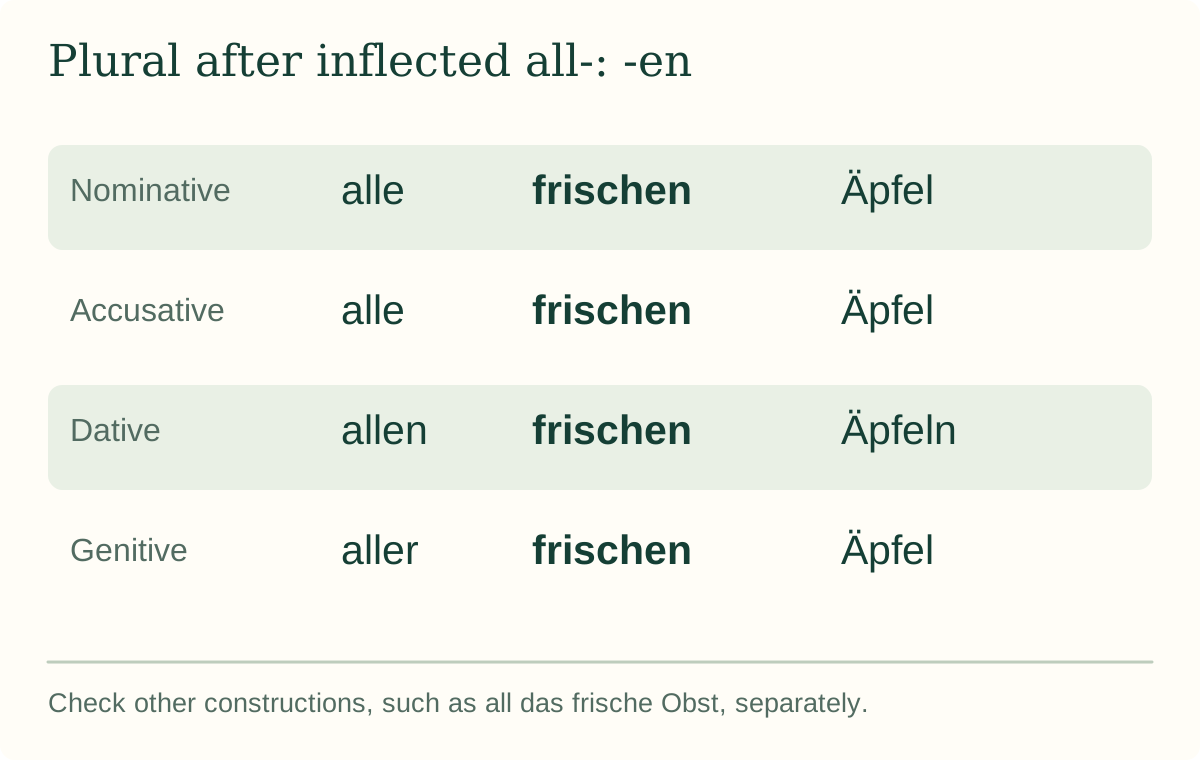
The adjective’s -en ending stays the same in this plural pattern. All- behaves differently: nominative and accusative use alle, dative allen and genitive aller. In the dative, check the noun form too.
You can use a dative-taking preposition to practise: mit allen frischen Äpfeln. The n in Äpfeln belongs to the noun, not the adjective. In frischen, -en is the adjective ending.
| Case | Phrase | Example sentence |
|---|---|---|
| Nominative | alle frischen Äpfel | Alle frischen Äpfel liegen hier. |
| Accusative | alle frischen Äpfel | Ich kaufe alle frischen Äpfel. |
| Dative | allen frischen Äpfeln | Ich backe mit allen frischen Äpfeln einen Kuchen. |
| Genitive | aller frischen Äpfel | Der Duft aller frischen Äpfel erfüllt den Raum. |
Why is it called weak declension?
The weak adjective pattern uses -e and -en. Which occurs depends on the noun phrase. In the plural phrase after inflected all- practised here, -en is appropriate.
Weak does not mean the ending is optional or unimportant. Read the forms aloud while separating the words: allen | frischen | Äpfeln. This shows which information is attached to which word.
bei allen neuen Angeboten
Allen, neuen and Angeboten belong to a dative plural phrase here.
die Beschreibung aller neuen Angebote
Aller neuen Angebote is a genitive attribute modifying Beschreibung.
Why all das frische Obst looks different
All can also appear uninflected before another article phrase. In all das frische Obst, das immediately precedes the adjective. The adjective ending therefore belongs to a different construction from alle frischen Äpfel.
Also check number: Obst is neuter singular in this example. The plural pattern with -en throughout cannot be applied directly. All das frischen Obst would apply the shortcut in the wrong place.
Ich verwende all das frische Obst.
In the accusative singular phrase shown here, the form is frische, not frischen.
Being near alle does not make an adjective attributive
In Alle Räume sind hell, hell describes the subject through sind. It is predicative and takes no attributive ending here. In alle hellen Räume, hellen instead directly modifies the noun as an attribute.
Do not ask only whether alle occurs somewhere in the sentence. Ask whether the adjective belongs attributively to this noun phrase. The distinction also helps with other articles and quantity expressions.
Solve a gap in the right order
First establish that this really is a plural phrase with inflected all-. Then check case using the sentence or preposition. Insert alle, allen or aller as appropriate, and add -en to the attributive adjective.
Finally check the noun. A correct adjective ending does not fix an incorrect noun form. If you instead see a singular phrase or another article, apply the general ending method to the actual construction.
Check your understanding
Try each task before opening the model answer. Open tasks can have other valid answers.
Complete the subject: Alle frisch__ Äpfel liegen in der Schale.
Answer and explanation
Alle frischen Äpfel liegen in der Schale.
After inflected alle in the plural, the attributive adjective takes -en here.
Complete the accusative object: Ich kaufe alle gefroren__ Beeren.
Answer and explanation
Ich kaufe alle gefrorenen Beeren.
The accusative plural phrase also takes the weak adjective ending -en after alle.
Complete the whole phrase after mit: all__ frisch__ Äpfel__.
Answer and explanation
mit allen frischen Äpfeln
Mit requires dative. The phrase has allen, the adjective ending -en and the noun form Äpfeln.
Complete der Duft all__ gelb__ Blumen. The flowers form a genitive attribute.
Answer and explanation
der Duft aller gelben Blumen
The genitive plural uses aller and gelben. The phrase further specifies Duft.
Which is suitable: „Ich verwende all das frische Obst“ or „Ich verwende all das frischen Obst“?
Answer and explanation
Ich verwende all das frische Obst.
This is an accusative singular phrase with das. The preceding plural rule does not apply to every use of all.
Complete only all-: bei all__ neuen Angeboten.
Answer and explanation
bei allen neuen Angeboten
Bei requires dative in this phrase; the form is allen.
Does hell take -en here: Alle Räume sind hell?
Answer and explanation
No: Alle Räume sind hell.
Hell is predicative here. It is not an attributive adjective within the noun phrase.
Write your own sentence with alle and an adjective before a plural noun.
Answer and explanation
For example: Ich lese alle kurzen Nachrichten.
Alle kurzen Nachrichten is an accusative object here. Other suitable original sentences are possible.
Other valid answers: Other suitable plural phrases after inflected all-.
Frequently asked questions
Does an adjective after alle always take -en?
Yes in the attributive plural phrase after inflected all- practised here. This is not a blanket rule for singular phrases, uninflected all before other articles, or predicative adjectives.
What changes between allen guten Ideen and alle guten Ideen?
Allen marks the dative plural phrase here. The adjective ending -en stays the same. With other nouns, also check whether the noun form changes.
Do viele and einige follow the same rule?
Not mechanically. Preceding words have different inflectional properties. Check each construction rather than extending the form learned after all- to every quantity expression.